
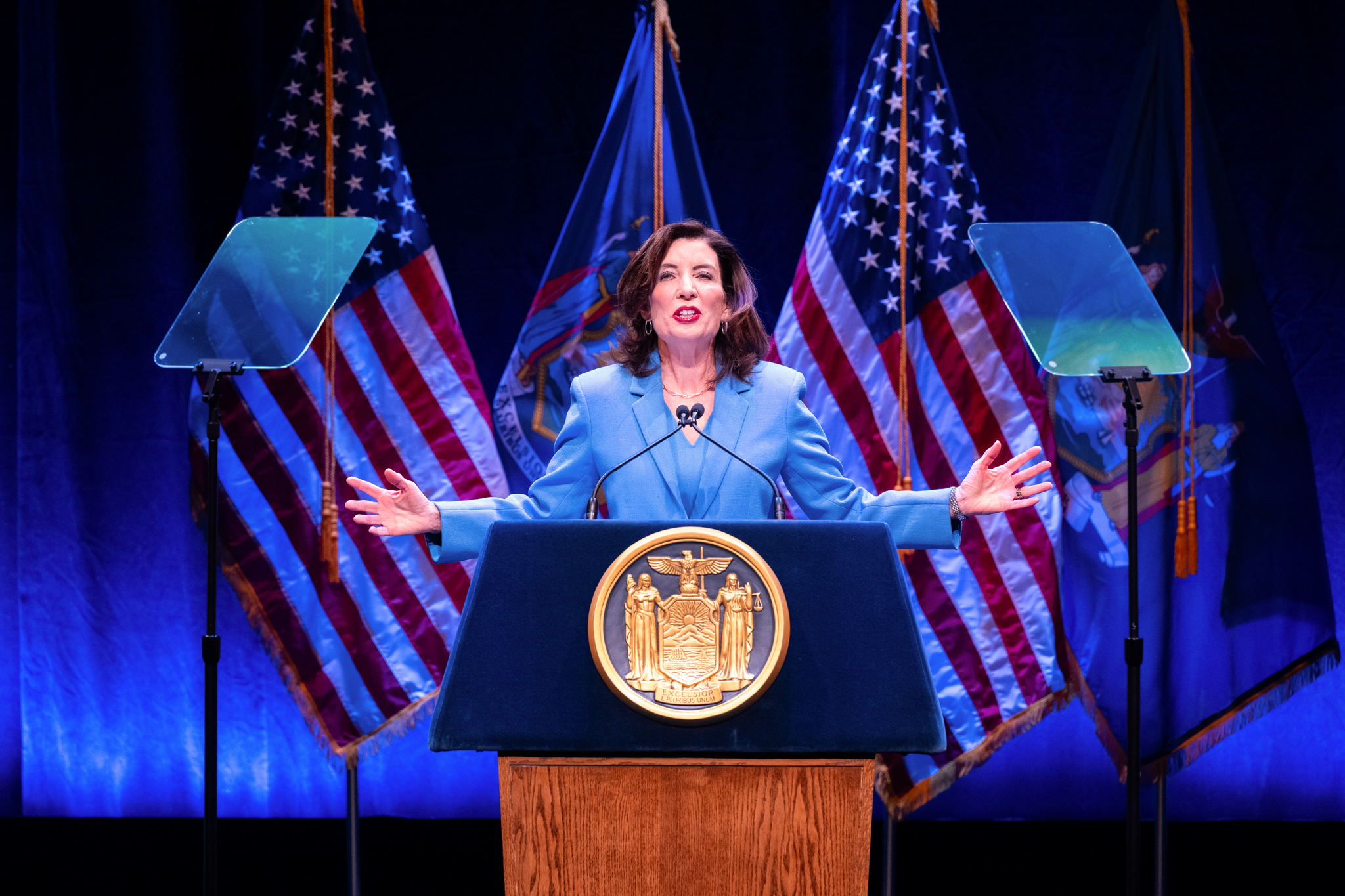
Albany lawmakers blew past New York’s official April 1 budget deadline, leaving more than $260 billion in public spending unresolved as negotiations over health care, housing, and climate policy grind forward.
The scale of what’s at stake is difficult to overstate. New York’s budget outpaces every other state except California, and this year’s final figure will likely land somewhere between the Assembly’s $266 billion proposal and the Senate’s $270 billion counter, with Gov. Kathy Hochul’s original $260 billion plan serving as the floor. The money funds everything from highway construction to health insurance for low-income residents, drawing on both state tax revenue and federal transfers.
But the budget isn’t just a spending plan. Albany lawmakers use it routinely to rewrite laws that have nothing to do with money. Last year’s budget loosened rules requiring prosecutors to share evidence quickly with defense lawyers and allowed the state to close several prisons. This year, Hochul’s proposal would partially roll back the 2019 law requiring New York to dramatically cut carbon emissions and shift toward renewable energy, a move that has drawn opposition from climate advocates who helped pass that legislation.
Also on the table: Hochul’s child care expansion, changes to housing construction rules, pension boosts, and the question of how the state will absorb cuts to federal health care funding that, according to The City, threaten to leave hundreds of thousands of New Yorkers without health insurance.
For residents of neighborhoods like Brighton Beach, Flatbush, or Mott Haven, that last item isn’t abstract. Federal Medicaid dollars flow directly into community health centers, home care agencies, and hospital emergency rooms across the five boroughs. A significant reduction in that funding hits the city’s safety net faster and harder than anywhere else in the state.
The budget itself runs to thousands of pages of dense legal language. Subjects range from car insurance to agriculture. The biggest shares of spending go to health care and education.
New York’s process is famously opaque. Three people sit at the center of every negotiation: the governor, the Assembly speaker, and the Senate majority leader. The public doesn’t get a transcript of those talks. Rank-and-file legislators often don’t see the final text until hours before a vote. Outside advocates, local officials, and ordinary New Yorkers feed in through public hearings held earlier in the process, but by the time a deal is close, the room has gotten very small.
“The budget process is not transparent,” said one longtime Albany observer who tracks fiscal policy at a state government reform organization. “It’s three people in a room and then everybody else finds out what happened.”
That opacity has real consequences. When lawmakers pack non-budget items into the spending plan, it’s harder to subject those changes to the kind of committee hearings and public scrutiny that standalone legislation would require. The rollback of climate mandates, for instance, wouldn’t necessarily go through the Environment Conservation Committee if it moves as a budget provision. It just moves.
The missed April 1 deadline isn’t unusual. New York spent most of the 1990s and 2000s passing budgets late, sometimes by months. Reforms in the early 2010s brought more on-time results, but deadline violations still happen when the core disputes are big enough. This year, with federal funding threats creating a genuine fiscal variable that negotiators can’t fully predict, the uncertainty has deepened the standoff.
What comes next is a final sprint of closed-door talks between the governor’s office and legislative leadership. Staff from the Division of the Budget will run numbers. Lobbyists will work their phones. City Hall will push for its own priorities, including school aid formulas and transit funding that directly affect the MTA’s operating budget.
New York City sends far more in tax dollars to Albany than it gets back in state aid, a structural imbalance that city officials have complained about for decades. That doesn’t change this year. But the size of the overall pot, and how it’s divided between health care, education, and everything else, will shape what city agencies can actually do in the fiscal year ahead.
The final budget will also carry whatever deal Albany strikes on climate, housing, and child care. Those aren’t separate tracks. They’re all inside the same document, negotiated together, and passed in a single vote.
Lawmakers don’t have a firm new deadline. They’ll keep talking until there’s a deal.