
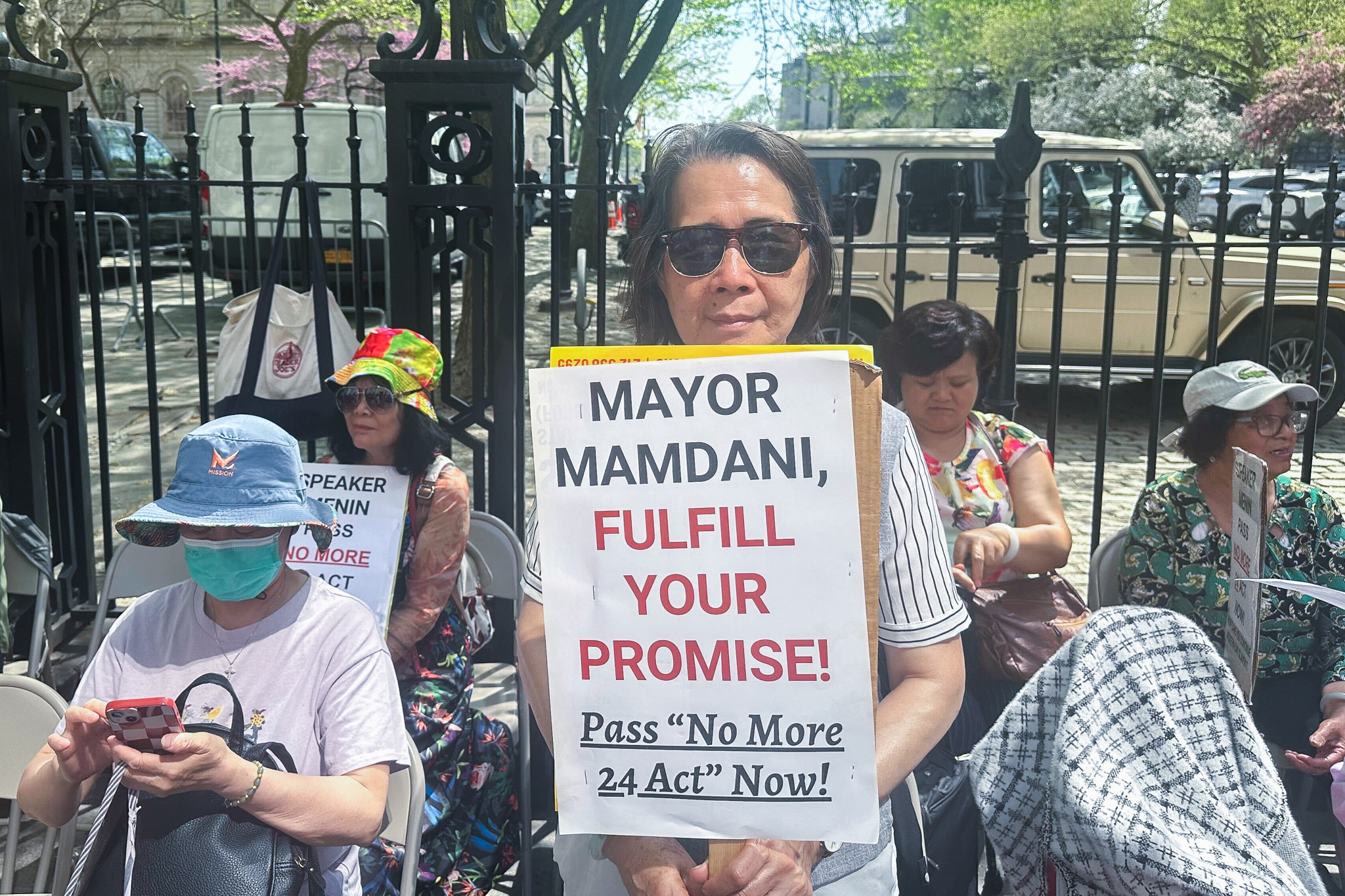
Fifteen home health aides launched an indefinite hunger strike outside City Hall on Thursday after the City Council failed to advance a bill that would ban 24-hour work shifts in the home care industry.
The workers, mostly immigrant women, joined about 40 colleagues holding “Stop the 24 Hr Work Day” signs on folding chairs in 85-degree heat beside the City Hall gates. The strike began at 1:00 p.m. It follows nearly a month of continuous protest at the same location.
Home health aide Yunfang Zhang, 70, said through an interpreter she joined the hunger strike because “home care workers cannot wait any longer, and our health has been destroyed.” Zhang added: “We cannot allow this to continue to the next generation.”
For more than a decade, live-in home care workers have sought to end state rules that allow 24-hour home care workers to be paid for only 13 hours a day. Those shifts are permitted as long as workers get three hours for meal breaks and at least five hours of uninterrupted sleep. Workers say they routinely spend up to 96 straight hours in the same home without real rest, while getting paid for only a fraction of that time.
The bill at the center of the dispute, introduced by Councilmember Christopher Marte of Chinatown, would replace 24-hour shifts with 12-hour shifts performed by two separate workers. It’s a structural change that sounds straightforward but has cracked apart a coalition that might otherwise agree. Workers’ rights activists support it. Many disability advocates don’t, at least not in its current form, because home care is heavily subsidized by state Medicaid dollars that the city can’t control. Some worker allies, including the city’s own worker protection agency, say the bill needs additional state funding behind it or it risks leaving vulnerable patients without care and workers without jobs.
That funding question has reportedly set Gov. Kathy Hochul against Council Speaker Julie Menin, pulling the politics in competing directions at both ends of the state capital and City Hall.
Mayor Zohran Mamdani said on the campaign trail that he supported ending 24-hour shifts, but his administration has pushed back on Marte’s bill over the same funding concerns. Asked about the bill last week, the mayor told The City he’s “long been supportive of any effort to recognize the immense labor of home care workers,” and would let the legislative process play out. That answer didn’t satisfy the workers outside.
Marte said he’s “optimistic” that he, Menin, and Hochul can reach agreement. That optimism hasn’t translated into a Council vote.
A previous hunger strike by about two dozen home care workers in 2024 ended after six days. Workers say they feel they have no other move left.
The stakes aren’t abstract for a city like New York. Brooklyn and Queens have some of the densest concentrations of home health aides in the country, a workforce that keeps thousands of elderly and disabled residents out of institutional care. Many of those aides live in the same immigrant neighborhoods as their clients. In Brighton Beach and Sheepshead Bay, you don’t have to look far to find a woman who has worked a 24-hour shift, come home to her own family, and gone back the next day. The labor is invisible until it stops.
The Fair Labor Standards Act sets federal minimums for wages and hours, but home care carve-outs have long allowed states to set their own rules for live-in workers. New York’s 13-hours-of-pay-for-24-hours-of-work standard has survived legal challenges before, and advocates say only a City Council bill or state legislative action can end it.
Right now, neither appears imminent.
Thursday’s hunger strike puts direct physical pressure on elected officials who’ve spent months trading position papers. Zhang and her colleagues aren’t waiting for the next budget negotiation. They’re sitting on folding chairs outside City Hall, in April heat, not eating.