
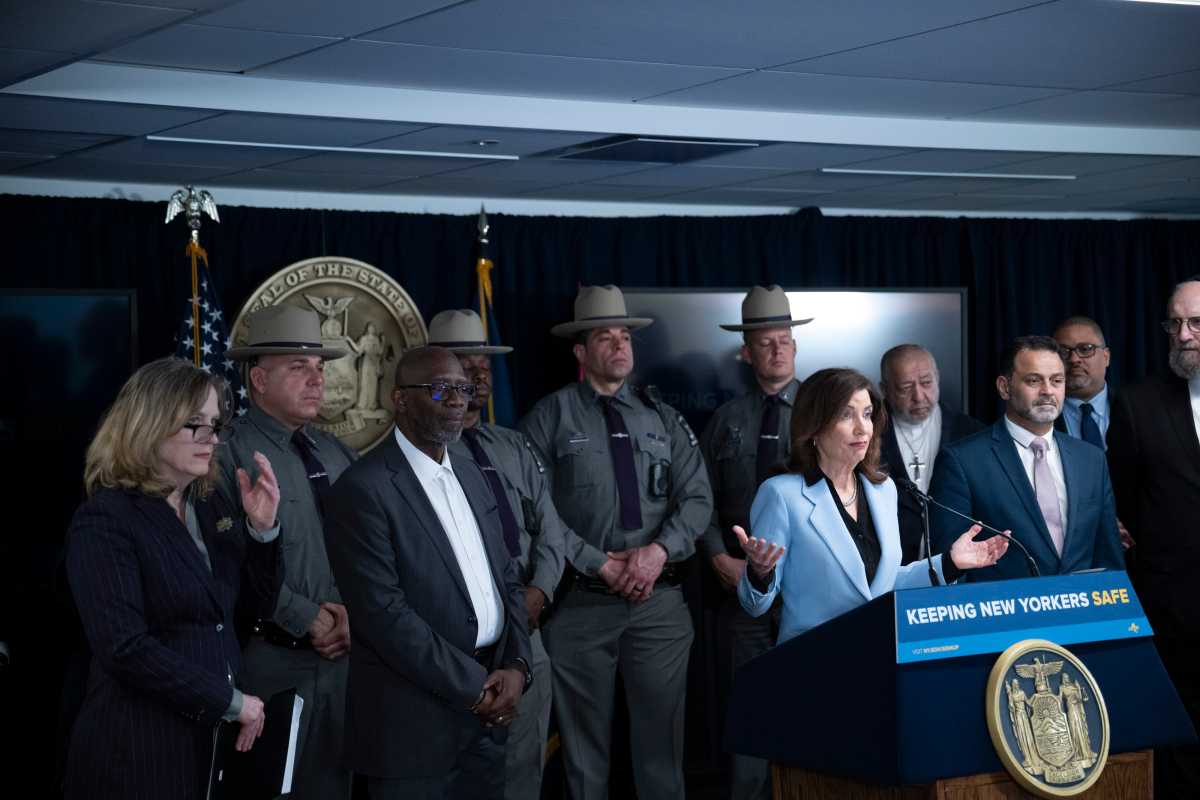
Gov. Kathy Hochul pushed Wednesday to put a 25-foot protest buffer around houses of worship statewide, pairing the proposal with $35 million in hate-crime security funding available now to vulnerable nonprofits.
The move renews a fight Hochul first launched during her fifth State of the State address in January, and it puts the governor well ahead of where New York City lawmakers landed. The City Council passed a far narrower measure that would require the NYPD to publish plans for handling protests near houses of worship rather than enforce a flat prohibition. Mayor Zohran Mamdani hasn’t signed it. Last month he said he was reviewing the bills amid “serious” constitutional concerns, telling reporters he was working to protect both “the right to prayer and the right to protest.”
Hochul didn’t back down Wednesday when reporters pressed her on whether a statewide buffer could survive court challenge. “Bring it on,” she said.
She argued 25 feet is a reasonable distance and that the state has a responsibility to protect the right to worship. She also tried to sharpen the policy’s edges. Police wouldn’t stand outside every church, mosque, and synagogue across New York. Enforcement would target areas where protests are expected or already happening, with the goal of giving worshipers enough room to enter a building without getting harassed on the sidewalk.
The proposal grew out of protests held outside synagogues in Manhattan and Queens, including Park East Synagogue and a synagogue in Kew Gardens Hills. Those demonstrations put the issue on the legislative radar last year and touched off a fight that has now outlasted one mayoral administration and is testing another.
Brooklyn Council Member Shahana Hanif voted against the council bill last month. She argued the legislation threatened protected speech, conflicted with the city’s existing protest settlement framework, and handed police too much authority to decide “when and where people can speak and organize.” The tension between that position and Hochul’s is not going away.
Hochul brought faith leaders to the podium Wednesday, and they didn’t stick to a single denomination. Rabbi Yeruchim Silber of Agudath Israel said it was critical that people of all faiths be able to worship safely. Mohammad Razvi of the Council of Peoples Organization said Muslim communities had seen a rise in anti-Muslim hate and needed resources to protect congregants. Rev. Robert Waterman of Antioch Baptist Church described an intruder who walked into his church during a Dr. Martin Luther King Jr. Day service, reached the pulpit, and left parishioners shaken.
That’s a real fear.
The multi-faith coalition gives Hochul political cover, but it doesn’t resolve the constitutional question. The 25-foot buffer proposal draws from a category of laws courts have scrutinized before. The First Amendment protects protest activity in traditional public forums, including sidewalks, and any content-neutral buffer zone law still has to clear tests on time, place, and manner restrictions. The U.S. Supreme Court struck down a 35-foot buffer around abortion clinics in McCullen v. Coakley in 2014, and that precedent will almost certainly get cited if this bill draws a legal challenge.
City Hall and Albany are now running parallel tracks on the same problem, and they don’t connect. Mamdani’s caution on the council bill signals he’s not ready to hand the NYPD a new enforcement mandate with First Amendment exposure. Hochul’s posture says she’s willing to let courts sort it out.
The $35 million through the Securing Communities Against Hate Crimes program is already open for applications, according to the governor’s administration. That money is meant for nonprofits and community organizations that face elevated risk. It’s the concrete, immediate piece of Wednesday’s announcement, and for a lot of houses of worship across the state, it matters more right now than the legal fight ahead.
Whether Albany can pass the buffer bill before the budget closes is another question. Hochul has the bully pulpit and she clearly intends to use it. But the Legislature knows the civil liberties argument, and it’s heard from the same advocates who pushed the City Council toward a softer version.
Hanif’s floor statement won’t be the last word on this.