
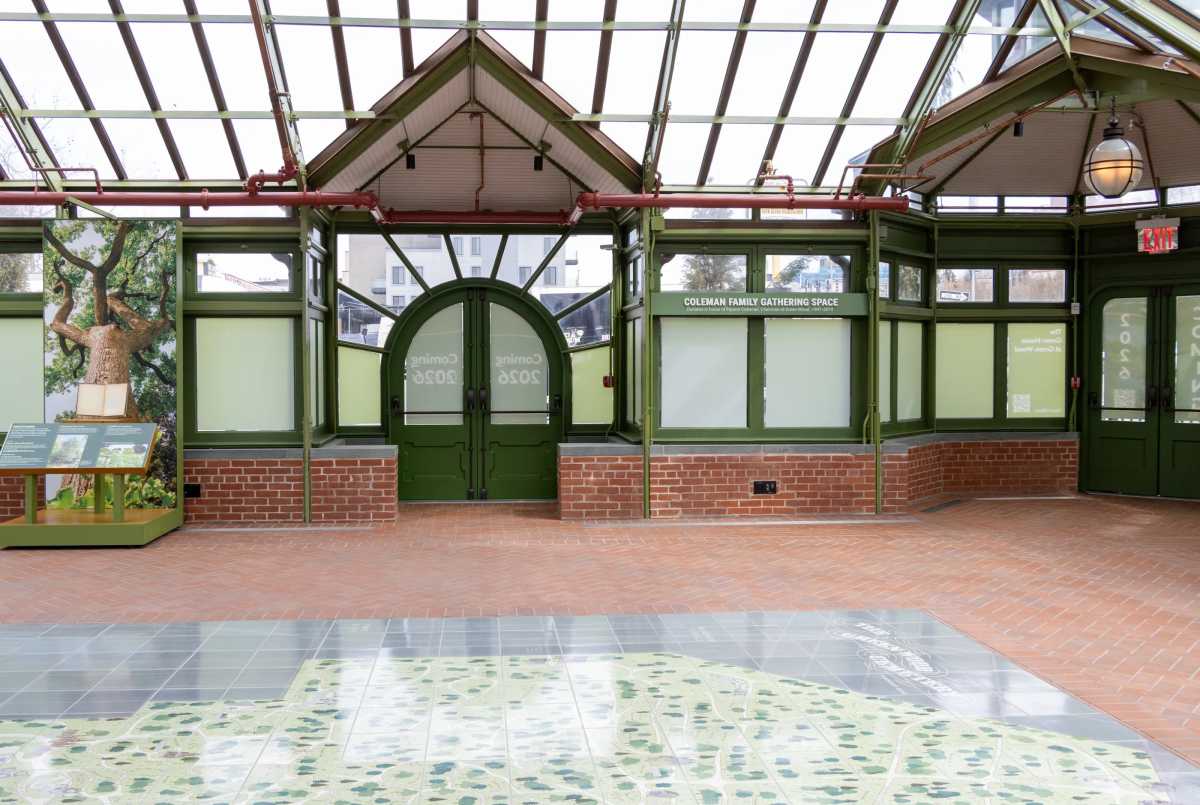
Green-Wood Cemetery opens its $43 million visitor center this weekend inside a restored Victorian greenhouse at Fifth Avenue and 25th Street in Sunset Park, Brooklyn.
The project has been more than a decade in the making, and it shows in the scale. The 19,200-square-foot facility wraps a new L-shaped, terra-cotta-clad building designed by Architecture Research Office around the rehabilitated Weir Greenhouse, a glass-and-copper structure with an onion dome that’s stood on the corner since the late 19th century. Green-Wood bought the greenhouse from McGovern Florists in 2012 for $1.625 million after the building had spent years sliding toward ruin, its frame buckling, window panes missing, plants long gone.
The cemetery sits directly across Fifth Avenue from 750 Fifth Ave. That proximity made Green-Wood the obvious buyer. It also made the restoration personal.
Lisa Alpert, senior vice president of development and external relations at Green-Wood, said the project came down to three concrete problems the cemetery couldn’t solve without a building like this. First, visitors needed a welcoming entry point that existed outside the cemetery gates. Second, the more than 500,000 people who visit each year had no real place to learn about the grounds or the hundreds of thousands of people buried there. Third, and maybe most practically, the cemetery’s educational programming, which draws around 10,000 schoolchildren annually, was hitting a hard wall every fall. “To a screeching halt around November 1,” Alpert said.
That’s fixed now.
The new facility includes exhibition galleries, classroom space, climate-controlled archival storage, offices for Green-Wood staff, restrooms, and seating. On weekends, visitors can buy flowers. A food option is still being worked out, though Baked in Brooklyn sits next door for anyone who doesn’t want to wait.
Alpert was direct about what makes this project unusual in a way that doesn’t get said often enough. “It’s not like we’re a museum opening another wing,” she told the Brooklyn Paper. “We are a cemetery opening a visitor center, which is sort of unheard of.”
She’s right. Cemeteries don’t do this. They tend to operate on the assumption that people who show up already know what they’re doing and why they came. Green-Wood’s argument is that this assumption has been leaving a lot of visitors, and a lot of potential visitors, without much help. “As an institution, we know so much about this place and so much about the people who are buried here, and we’re not sharing,” Alpert said. “We just didn’t have a place for us to impart those stories and share them.”
The Weir Greenhouse itself carries most of that history visually. The Victorian structure’s distinctive mesh signage and copper dome made it a neighborhood landmark long before Green-Wood got involved. Its previous life as a florist shop wasn’t incidental. The corner site fed directly into the cemetery ecosystem for generations, with the greenhouse selling flowers to visitors and a now-demolished neighboring building selling monuments. That commercial relationship between the living and the dead, between grief and commerce, ran on this block for more than a century.
Green-Wood is one of the country’s oldest and most historically significant burial grounds. The National Historic Landmark holds the remains of figures ranging from Civil War generals to artists to politicians. Its 478 acres include hills, ponds, and some of the best elevated views of Lower Manhattan you can get without buying a ticket to something. Tourists and locals walk its paths regularly, but until now, the cemetery had no real infrastructure to meet them at the door.
Architecture Research Office’s design tries to bridge that gap without overwhelming the Weir Greenhouse. The terra-cotta cladding on the new L-shaped building references the masonry palette of the surrounding Sunset Park neighborhood while giving the restored greenhouse room to stay the focal point. That’s a harder architectural problem than it sounds, and the $43 million price tag reflects it.
The visitor center serves Green-Wood’s staff, its living visitors, and in some sense, the 500,000-plus people buried on the grounds. Alpert said the goal is to reach people who’ve never considered walking through the gates, not just the ones who already make regular trips. The center gives the cemetery a way to make its case to both groups at once, through exhibitions, programming, archival access, and simple orientation for anyone who’s ever stood outside a cemetery gate and wasn’t sure what the etiquette required.
The doors open this weekend on Fifth Avenue and 25th Street.