
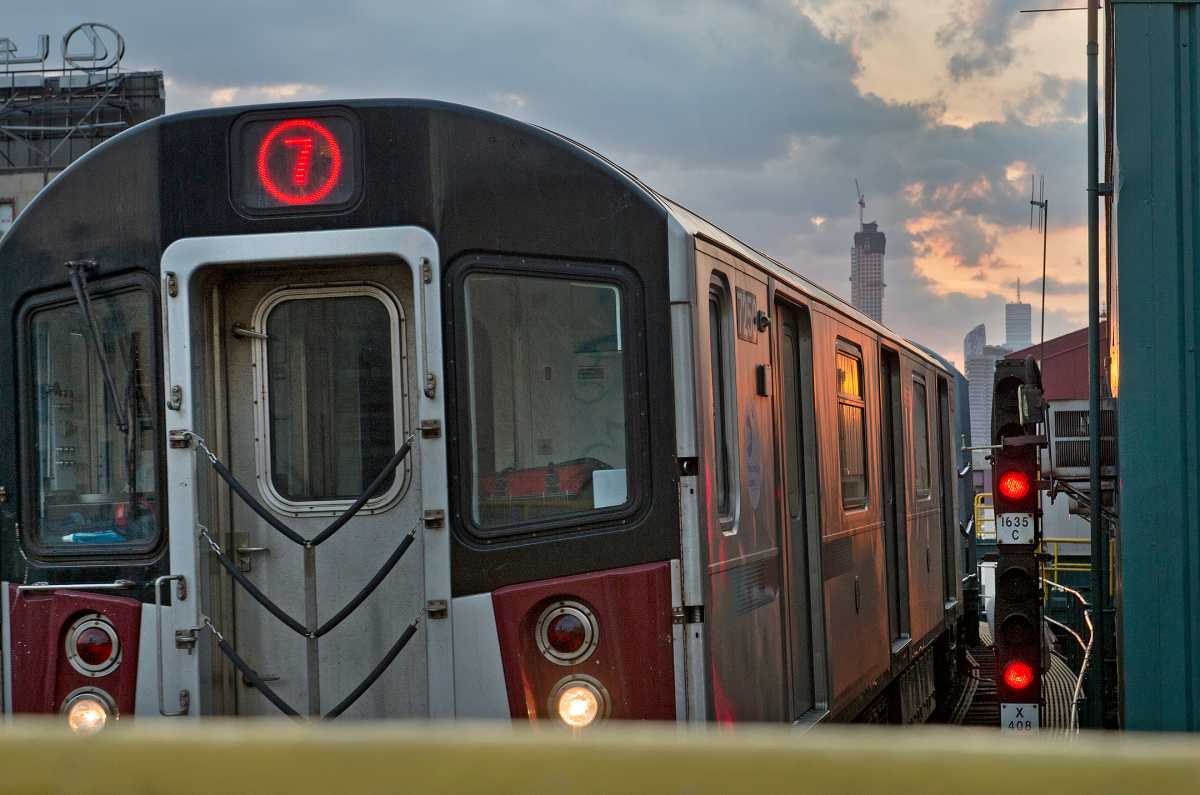
A man died Tuesday morning after falling onto the tracks at the Junction Blvd station in Queens, leaving 7 train riders scrambling for alternate routes during the peak commute.
Police arrived at 7:11 a.m. to the Manhattan-bound platform at Junction Blvd, a station sitting on the border of Jackson Heights and Corona that falls under the NYPD’s 115th Precinct and Transit District 20. Officers found an unconscious and unresponsive man on the tracks. He was pronounced dead at the scene. The victim’s identity has not been released.
An eyewitness saw the man fall, and police said they don’t suspect any criminality. This wasn’t a push, a shove, a crime. It was a man going down onto the tracks, and that’s the kind of death that hits riders differently, a reminder of how quickly a morning can turn.
The MTA suspended 7 train service in the immediate aftermath, then restored partial service with significant restrictions still in place as of Tuesday morning, as AM New York reported. The 7 is currently running local only between 74th St-Broadway and Mets-Willets Point, with delays throughout the line. For the hundreds of thousands of Queens riders who depend on the 7 to get to Midtown, that’s a painful disruption on a Tuesday when there’s no obvious workaround that doesn’t add 20 or 30 minutes to your ride.
The MTA is directing Queens commuters to use the E, F, M, or R trains as alternatives. Those lines run along Queens Boulevard and can absorb some 7 train volume, but anyone who’s stood on a packed F train platform at Roosevelt Avenue during a normal rush hour knows that absorbing extra ridership on a suspended-service morning is a different animal entirely. The E and F run express and local respectively along a parallel corridor, and the M and R provide local options, but none of them replicate the 7’s direct shot into Times Square and Hudson Yards.
“The 7 train is running local between 74th St-Broadway and Mets-Willets Point and with delays,” an MTA spokesperson told reporters Tuesday morning.
It wasn’t the only incident on the system before 9 a.m. Police also responded to a separate track intrusion at the 86th Street station on the 5 line, on Manhattan’s Upper East Side, within the 19th Precinct. That situation ended without serious injury. The person was able to get off the tracks before a train struck them. Two track incidents in a single morning rush, even with very different outcomes, raises real questions about platform safety and the barriers, or lack of them, between riders and the roadbed. New York has no systemwide platform screen door program in place, and the MTA has moved slowly on exploring that kind of infrastructure investment.
Track fatalities and near-misses put the entire system into reactive mode. Operators hold trains. Controllers reroute service. Passengers pile up on platforms. The ripple effect from a single incident at Junction Blvd at 7:11 a.m. gets felt at Flushing-Main Street, at Queensboro Plaza, at Grand Central, all the way down the line. That’s the geometry of a subway system that runs 24 hours with no physical separation between people and moving trains.
For riders who live along the 7 corridor through Woodside, Elmhurst, and Corona, the E, F, M, and R alternatives require getting to a Queens Boulevard station, which isn’t always a short walk. Some riders don’t have that flexibility. Parents getting kids to school, workers with strict start times, people connecting to other trains downtown, they’re absorbing the cost of this morning’s tragedy in delays and reroutes.
The NYPD transit bureau has jurisdiction over incidents on the system’s tracks and platforms and works alongside MTA personnel when a person is struck. Processing a scene and restoring service both take time, and Tuesday morning’s response at Junction Blvd followed that same sequence: officers arrived, found the victim, secured the scene, and service modifications stayed in effect as the investigation continued. The 7 line carries an estimated 450,000 daily riders, making it one of the busiest lines in the system, and even a partial suspension during the morning peak sends thousands of people hunting for alternatives on an already crowded network.