
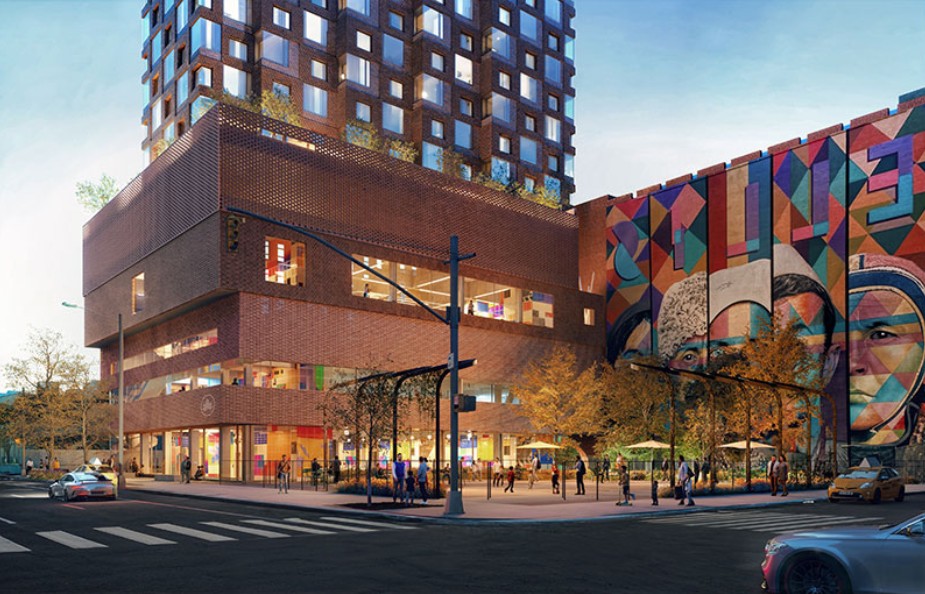
Greenwich Village community groups are pushing back against a planned 31-story affordable housing tower at 388 Hudson St., citing the developer’s record of housing violations and demanding hard guarantees that the building won’t eventually flip to market rate.
The city selected Camber Property Group, Services for the UnderServed (S:US), and Essence Development to build the Hudson Mosaic project on the city-owned lot in the final weeks of the Adams administration last December. City officials described the project as “first-of-its-kind,” combining roughly 280 homes with a publicly accessible recreation center. At approximately 400 feet, the building would be the tallest structure in Greenwich Village.
Plans call for 100% permanently affordable units, with rents set between 40 and 100% of the Area Median Income.
But Camber’s track record is what’s drawn fire.
Public Advocate Jumaane Williams ranked the company’s founding principal, Rick Gropper, 17th on his list of the city’s worst landlords, pointing to more than 1,000 open HPD violations and 28 evictions at other Camber-managed properties. That history has alarmed residents and preservation groups who argue the city chose poorly when picking a developer for a project it’s billing as a landmark affordable housing effort.
Andrew Berman, executive director of Village Preservation, a non-profit that advocates for architectural heritage in Greenwich Village, NoHo, and the East Village, didn’t mince words about the selection. He called it a “questionable choice at best.”
Berman’s concerns don’t stop at Camber’s landlord record. He told the Evening Mail that he wants iron-clad contractual commitments ensuring the building stays affordable long term. The way the project is currently being pitched, he said, raises red flags about its actual intentions.
“They’re designing it to be as tall as possible. They talked about ensuring that every apartment had river views. It almost sounds as though it’s being designed to eventually become market rate,” Berman said.
Village Preservation says the city referenced a “regulatory agreement” with Camber at a recent Manhattan Community Board 2 meeting that would lock in permanent affordability. The group isn’t buying it. Without written details, they say the promise is hollow.
“This is little changed from past statements from the City that claimed to offer guarantees without backing them up,” the group said in a post.
Local resident and community activist Sommer Omar said city representatives couldn’t give a straight answer when pressed at that same CB2 meeting. She said she asked multiple times what legal tool the city would actually use to enforce affordability. She didn’t get one.
AMNY’s coverage of the dispute reflects how deeply skeptical residents have become after repeated rounds of promises that didn’t hold. That skepticism isn’t abstract. It’s rooted in watching other “affordable” developments in Manhattan shed their affordability protections once financing structures allow it.
The project raises a second, separate concern for the neighborhood.
Gone would be any clear future for the nearby Tony Dapolito Recreation Center, which has sat shuttered for several years. Community members want to know whether Hudson Mosaic’s built-in recreation center is a genuine public amenity or a quiet way to sideline any plan to reopen Dapolito. The city hasn’t offered a direct answer on that either.
For its size and complexity, Hudson Mosaic is moving through the pipeline with limited public detail attached to it. The community board process is meant to surface exactly these questions, but advocates say the city’s representatives showed up to that forum without the documentation needed to answer them. A regulatory agreement that no one can read isn’t a commitment. It’s a placeholder.
Village Preservation’s position is that the city should either produce the enforceable legal language now, in writing, or acknowledge that the permanence of the affordability hasn’t been secured. Berman said his group wants to see the agreement, not hear about it.
The New York City Department of Housing Preservation and Development has not publicly released the terms of the regulatory agreement as of this reporting. The lot at 388 Hudson St. sits in a neighborhood where development battles have a long history, and residents here know what it looks like when a project gets approved on one set of terms and built on another.
With the Adams administration gone and a new city government now holding the file, advocates say they’ll keep pressing for answers before any ground breaks.