
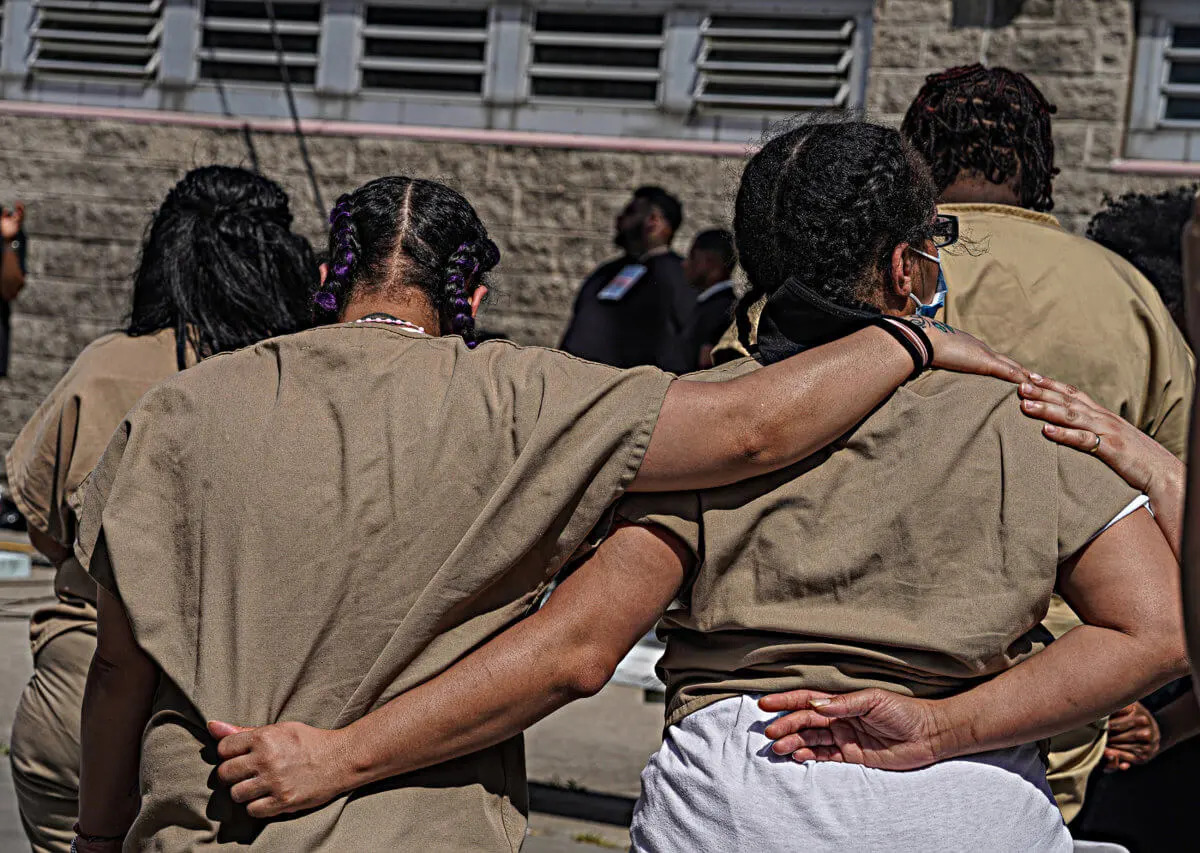
Members of the New York City Council’s Committee on Criminal Justice toured Rikers Island Monday, pressing corrections officials on the treatment of pregnant women held at the facility.
Committee chair Council Member Selvena N. Brooks-Powers led the visit alongside Council Members Gale Brewer and Yusef Salaam, both representing Manhattan districts. The three lawmakers spent the morning at the Rose M. Singer Center, the jail’s women’s facility, meeting directly with people in custody and documenting what they found. Brooks-Powers called it her first visit since taking the helm of the committee.
What they saw troubled them. Brooks-Powers told reporters she found pregnant women scattered across the jail rather than housed together near the nursery, a situation she called dangerous for both the women and their unborn children. She made a direct plea to the corrections department to consolidate pregnant incarcerated people into the nursery unit.
“The baby that they’re carrying is not an extension of the sentencing,” Brooks-Powers said. “The baby should be properly cared for. They should get the proper care that they would get anywhere else.”
The visit comes as Rikers has faced years of scrutiny over dangerous conditions, chronic understaffing, and rising in-custody deaths. The Department of Correction remains under a federal monitor appointed to oversee court-ordered reforms. Progress has been slow, and city officials and advocates have clashed repeatedly over timelines and accountability.
Brooks-Powers spoke with at least one pregnant woman who said staff were providing regular prenatal care. That’s something. But the broader picture the chair painted was of a facility where pregnant women don’t always get the proximity to medical support they need, and where the population of incarcerated mothers gets far less attention than it warrants.
Brooks-Powers didn’t shy from describing the weight of her new role. It’s heavy work, she said.
“It’s so heavy, and, as we continue the conversation to close Rikers and transition to the borough-based jails, we want to make sure that we are keeping those in custody as well as those who are working behind the walls and returning to community safe and with dignity, but at the same time ensuring that we have safety,” she told amNewYork.
Brewer added her own accounting of what the delegation witnessed inside the Rose M. Singer Center, which incarcerated New Yorkers and staff have long nicknamed “Rosies.”
“We spoke directly with the women at the Rose M. Singer Center, young men, and detainees with severe mental illness,” Brewer said. “It is clear that decisions affecting pregnant people in custody require close attention and follow-through. Oversight means showing up, asking questions, and making sure conditions improve now.”
That framing, oversight as physical presence rather than paperwork, reflects a frustration that has built among council members who feel the city’s corrections apparatus doesn’t respond to pressure unless someone is literally standing in the building watching.
The city has committed to closing Rikers and replacing it with a network of smaller borough-based jails, a plan that has faced delays and fierce neighborhood opposition at each proposed site. The Board of Correction, the oversight body that monitors jail conditions, has repeatedly flagged the Rose M. Singer Center for inadequate medical care, poor physical infrastructure, and insufficient programming for women. The council’s visit Monday puts fresh political weight behind those existing findings.
Brooks-Powers described criminal justice oversight as requiring what she called careful consideration and compassion on questions that can split voters and officials alike. She didn’t pretend any of it is easy. “It’s not a clear path with any of these aspects when we talk about criminal justice,” she said.
What Monday’s tour made clear is that the council’s criminal justice committee intends to treat Rikers as a hands-on oversight target, not a subject to address only through hearings in lower Manhattan. Brooks-Powers’ goal, she said, is to see the island close permanently, but she was explicit that closing it doesn’t excuse letting conditions deteriorate in the meantime. The women inside the Rose M. Singer Center, including those weeks away from giving birth, can’t wait for a long-term plan to catch up to them.
Advocates at groups like the Correctional Association of New York have monitored conditions at women’s facilities in state and city jails for decades and have pushed for exactly the kind of council attention Brooks-Powers, Brewer, and Salaam showed up to provide on Monday.