
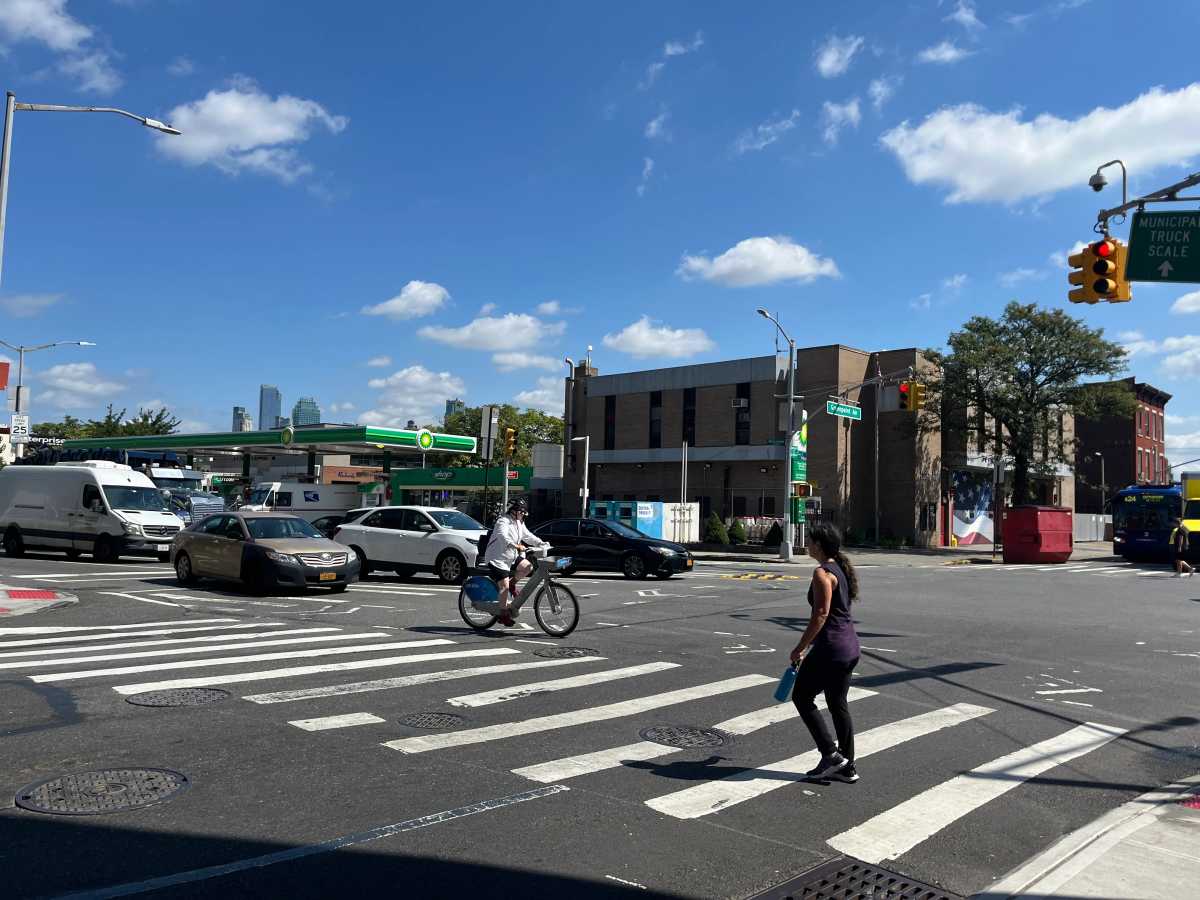
Cyclist counts on McGuinness Boulevard have more than doubled since 2021, and city officials say the data backs a full expansion of the corridor’s redesign northward to Freeman Street.
The Department of Transportation presented findings to Community Board 1 on April 14, showing that a partial lane reduction along the southern stretch of the boulevard has produced measurable results: fewer cars during peak hours, a more diverse cycling population, and travel delays far smaller than critics predicted when the project launched.
DOT engineer Zach Wyche walked the board through the numbers. South of Greenpoint Avenue, between 100 and 400 fewer vehicles pass through during peak hours compared to pre-redesign counts. Driving north, weekday travel from Meeker Avenue to Calyer Street takes roughly one additional minute. Driving south, the delay runs between five and 60 seconds. That’s it. Not gridlock. One traffic light cycle, or less.
The redesign converted one vehicle traffic lane in each direction into a parking-protected bike lane between Calyer Street and Meeker Avenue in 2024. Fears that the change would push overflow traffic into surrounding blocks have only partially come true: volume north of Greenpoint Avenue has risen, and more cars are now running through Leonard and Humboldt streets, which run parallel to the boulevard.
Still, the DOT considers the southern results strong enough to justify extending the full redesign up to Freeman Street, as Mayor Zohran Mamdani pledged on his third day in office. Mamdani said the city would move forward “as soon as the weather warms,” and with temperatures hitting unseasonable highs this spring, the agency returned to CB1 to present its data and hear community feedback before proceeding.
The story of this project doesn’t start in 2024. The full redesign of McGuinness Boulevard was approved in 2023, then killed after one of then-mayor Eric Adams’s top aides was allegedly bribed by local business owners who opposed the plan. The city eventually landed on a compromise: the full redesign on the southern half, minor changes to the northern half. That history hangs over every conversation the DOT has with Greenpoint residents about what comes next.
Wyche told the board the cycling numbers tell a clear story. The share of cyclists riding on the sidewalk dropped dramatically. In 2021, about half of people biking on McGuinness Boulevard used the sidewalk. Today, almost all of them ride in the street. That shift reflects what researchers have found more broadly: cyclists don’t take protected lanes because they’re convenient. They take them because they feel safe.
The lanes are also changing who bikes there.
Before the redesign, McGuinness Boulevard drew mostly experienced commuters. Now the DOT is seeing casual Citi Bikers, slower cyclists, and families on the route. Wyche attributed the change to the physical separation the parking-protected design provides. A painted line doesn’t change who shows up. A parked car buffer does.
Cycle trips across the Pulaski Bridge, at the northern end of the boulevard, are up 11% since the redesign went in. Brooklyn Paper coverage of the CB1 presentation documented Wyche’s remarks and the range of neighbor feedback the board received. Community Board 1 covers Greenpoint and Williamsburg, neighborhoods that have watched this corridor evolve through years of advocacy, political interference, and compromise.
The northern half of McGuinness Boulevard, from Greenpoint Avenue up to Freeman Street, still runs on the old configuration. That’s where the DOT’s next phase will focus. The city hasn’t announced a construction start date, but the agency’s return to CB1 this month signals the timeline is moving. Mamdani’s commitment was public and specific, and the DOT’s data presentation appears designed to build the case with residents before work starts rather than after.
For years, the argument against removing a lane on McGuinness was that the neighborhood couldn’t absorb the traffic impact. The NYC DOT data from the past year and a half doesn’t support that argument for the southern section. Whether the northern stretch presents different challenges, given the traffic volume increases already documented north of Greenpoint Avenue, is a question the agency will have to answer as it finalizes designs and engages with residents along the remaining corridor.
What the DOT has now is 18 months of data from a live street, a mayor who has committed publicly to expansion, and a community board that has seen the southern half perform. The protected bike lane research supporting these design choices has been consistent for years. Wyche’s presentation added a Brooklyn data point to that body of evidence.