
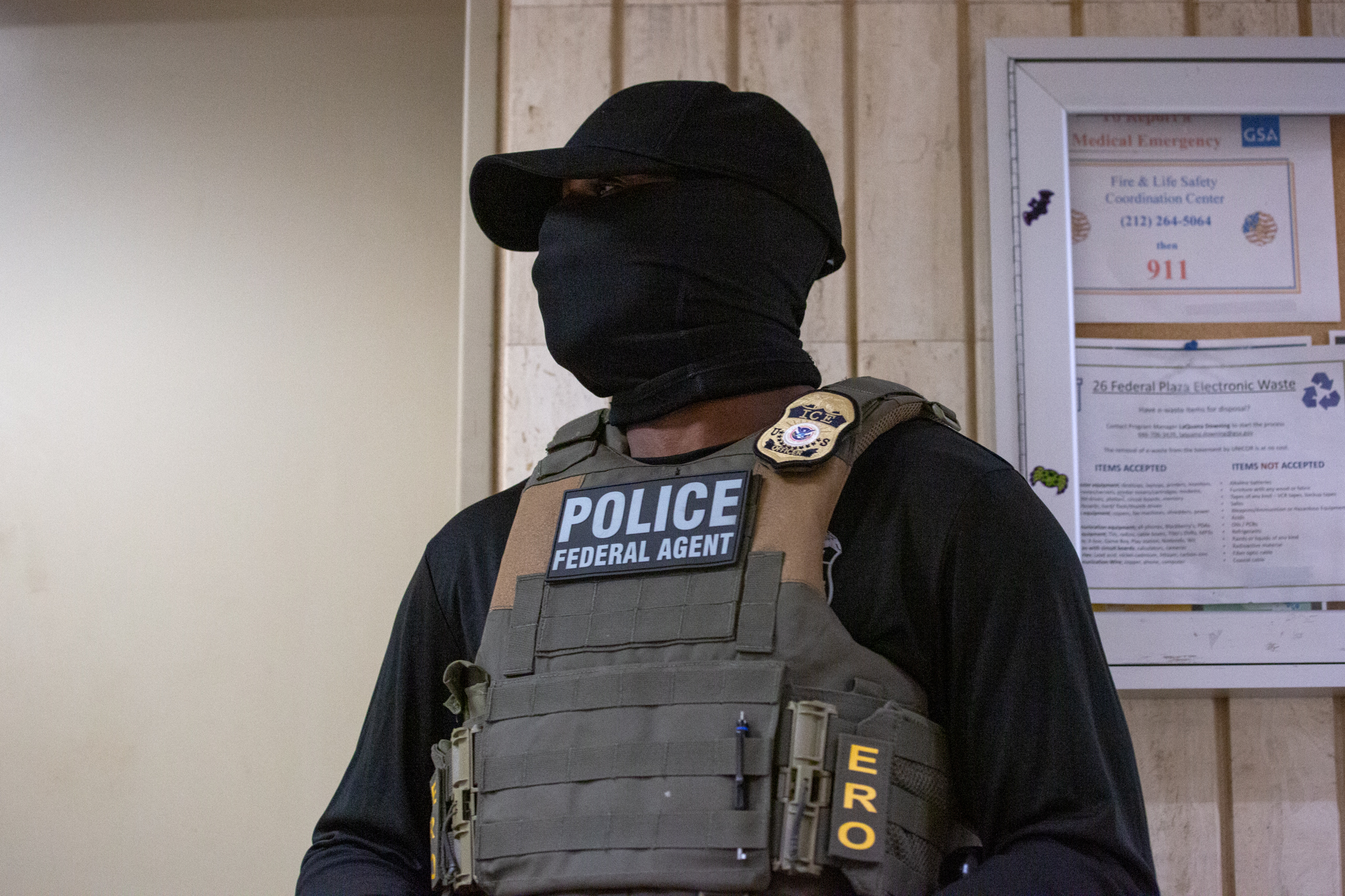
Nassau County police handed a Hicksville man over to federal immigration agents after a late-night traffic stop in January, the latest case in a pattern of local law enforcement cooperation with ICE that extends well beyond New York City’s sanctuary protections.
The man and his girlfriend were pulled over around 11 p.m. for a suspended registration. Officers held both overnight at the precinct, then released the woman the next morning with a desk appearance ticket. She watched her boyfriend walk out shackled beside an officer who identified himself as FBI, according to a federal habeas corpus petition filed in the Eastern District of New York. He called her from immigration detention later that day.
That case is one of roughly three dozen arrests that THE CITY identified after reviewing habeas petitions filed in federal courts across New York City and New Jersey between October 2025 and March 2026. In each case, local police departments allegedly collaborated with U.S. Immigration and Customs Enforcement to apprehend immigrants who had no warning of what was coming.
The pattern holds across the region. Most of the cases occurred in Nassau County, where the sheriff and police departments hold expansive agreements with ICE that deputize local officers to carry out immigration enforcement under the federal 287(g) program. But Nassau wasn’t alone. THE CITY also found cases in Port Chester, Mount Vernon, and Monticello, none of which have formal agreements with the Department of Homeland Security. In those communities, local police and probation officers allegedly tipped ICE to undocumented immigrants they had encountered, rather than making immigration arrests themselves.
No sanctuary. No formal agreement. Just a phone call.
Every one of the cases identified by THE CITY happened in cities and towns outside New York City’s sanctuary framework, leaving local law enforcement legally free to share information with federal immigration authorities and to coordinate operations with ICE agents. City residents have had those protections for years. People twenty miles east in Hicksville or north in Mount Vernon don’t.
That gap is exactly what state legislators are trying to close. The New York for All Act, sponsored by State Senator Andrew Gounardes of Brooklyn and Assemblymember Karines Reyes of the Bronx, would restrict cooperation between local police departments and federal immigration authorities except in specific circumstances. The bill has dozens of co-sponsors and the support of multiple immigrants rights groups and the NYCLU. Final deliberations are ongoing in the state legislature.
Gov. Kathy Hochul’s position has shifted as pressure from both sides has built. She initially put forward a more limited proposal that would end contracts with local jails and terminate the 287(g) agreements that let local officers perform immigration enforcement. Last Thursday she offered a broader version that would restrict communication between local authorities and ICE unless officials had probable cause of a misdemeanor or felony crime.
“This is not done,” Hochul said, according to THE CITY’s reporting.
Advocates and co-sponsors of the New York for All Act have pushed back on Hochul’s probable cause standard, arguing it still leaves too much discretion in the hands of local departments whose officers have demonstrated they’ll work around any ambiguity when it comes to turning people over to ICE.
The Nassau County Police Department didn’t return a request for comment on the Hicksville case. The man’s lawyer also didn’t respond. That silence is consistent with how Nassau has handled public questions about its ICE cooperation more broadly. The department’s 287(g) agreement with the Department of Homeland Security is public record, but the mechanics of how that coordination works in practice, including which encounters trigger a call to federal agents and which don’t, have never been fully disclosed.
What the habeas petitions show is a system that operates largely outside public view, one where a traffic stop for a suspended registration can become an immigration arrest by morning. The cases span six months and two federal court districts, and they involve a range of law enforcement agencies, precincts, and probation offices. What they share is a common outcome: a person in a community without sanctuary protections encounters local police, and within hours is in federal immigration custody.
Gounardes and Reyes haven’t set a public timeline for a floor vote on the New York for All Act, but the volume of habeas petitions landing in Eastern District courtrooms suggests the urgency isn’t going away. Each petition represents a person challenging their detention. Thirty-six cases in five months is a pace that adds up fast.