
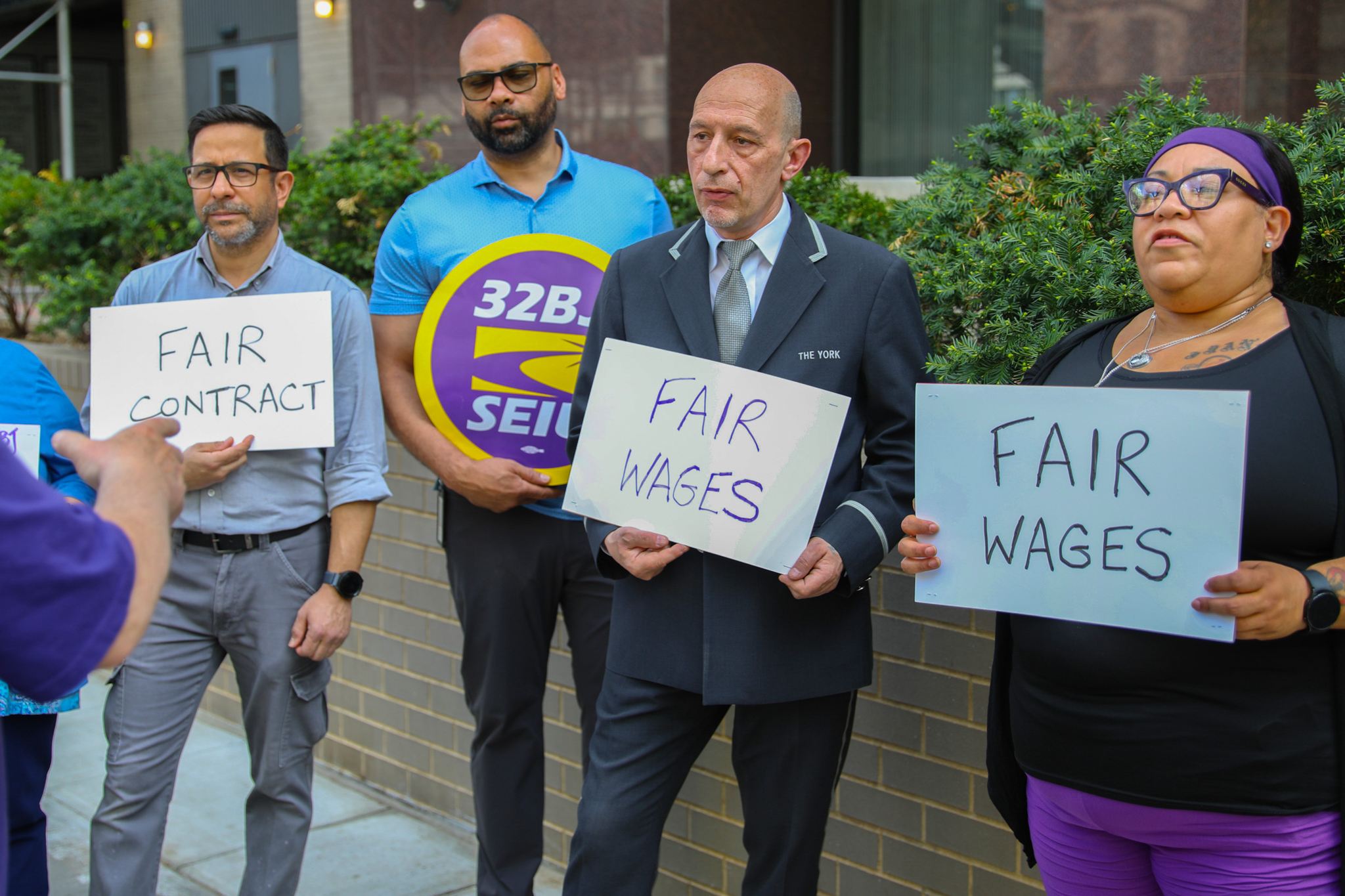
A threatened strike by more than 34,000 New York City doormen and porters ended Friday before it began, as their union reached a tentative agreement with the landlord group representing some of the city’s most expensive residential buildings.
32BJ SEIU and the Realty Advisory Board hammered out the deal after marathon negotiations held all week in a ballroom at the Midtown Hilton Hotel. The terms were not immediately disclosed. Representatives for both sides were scheduled to brief the press later Friday.
The stakes were real for hundreds of thousands of New Yorkers. More than 550,000 city residents live in buildings served by unionized doormen and porters, stretching from rent-stabilized apartment towers to luxury skyscrapers along Billionaire’s Row and iconic co-ops like The Dakota.
Workers had pushed back hard against management’s central demand: that employees begin contributing to their own healthcare costs for the first time, a benefit currently paid entirely by employers. The Realty Advisory Board had argued it couldn’t hold the line on labor costs given rising expenses and Mayor Zohran Mamdani’s pledge to freeze rent increases on stabilized apartments.
The two sides don’t have a long history of getting this close to the edge. The last time residential building workers actually walked off the job was 1991, a stoppage that stretched 12 days. They came within 24 hours of striking in 2022 before landing a deal.
This week followed a familiar script, but the pressure was higher.
On Wednesday, more than 10,000 workers rallied on Park Avenue ahead of the strike authorization vote, joined by Mayor Mamdani. Building managers had already started preparing residents for disruptions, requesting volunteers to take out the trash and warning that delivery services could be affected. At luxury co-ops like the San Remo on the Upper West Side, the prospect of a work stoppage prompted building management to begin coordinating contingency plans with residents.
32BJ SEIU, which represents doormen, porters, and other residential building workers across the city, told its members going into this week’s final stretch of talks that healthcare was the line it wouldn’t cross. The union has consistently fought to keep employer-paid coverage intact across multiple contract cycles. The Realty Advisory Board, for its part, said it had to find cost savings somewhere, pointing to the Mamdani administration’s rent freeze policy as a constraint on landlord revenue.
The healthcare fight reflects a broader tension playing out in labor markets across the country as employers push to shift medical costs onto workers. In New York’s luxury residential sector, where service and prestige are the selling point and residents pay six and seven figures for apartments, management companies have historically had less room to erode working conditions without backlash from high-profile tenants.
It didn’t hurt that the political environment tilted toward the workers. Mayor Mamdani’s appearance at Wednesday’s Park Avenue rally was not a neutral act. He showed up. That matters. His administration has been openly skeptical of landlord arguments about financial strain, particularly from owners of high-end properties who’ve seen asset values climb through years of a tight Manhattan market.
The Realty Advisory Board, which represents landlords at some of the city’s toniest condos and co-ops, has navigated these negotiations before, and its members were well aware that a 12-day strike like the one in 1991 would cost residents more in disruption than any healthcare concession would save in the short term.
Still, the tentative deal reached Friday isn’t a final contract, and the full details reported by THE CITY underscore how much ground the two sides covered under time pressure. The agreement must still be ratified by the membership, and 32BJ SEIU hadn’t released specifics as of Friday afternoon. A full briefing with press was expected later in the day.
For building residents across Manhattan, Brooklyn, and the Bronx who had been bracing for the disruption, Friday brought relief. Delivery access, building security rotations, trash removal schedules, all of it had been on the table if talks collapsed.
The 32BJ SEIU contract covers workers in buildings that span the full range of New York residential life, from working-class co-ops where residents scrape together maintenance fees to the glass towers on 57th Street where penthouses trade at nine figures. All of those buildings share one thing: they depend on the workers who just won themselves another deal.