
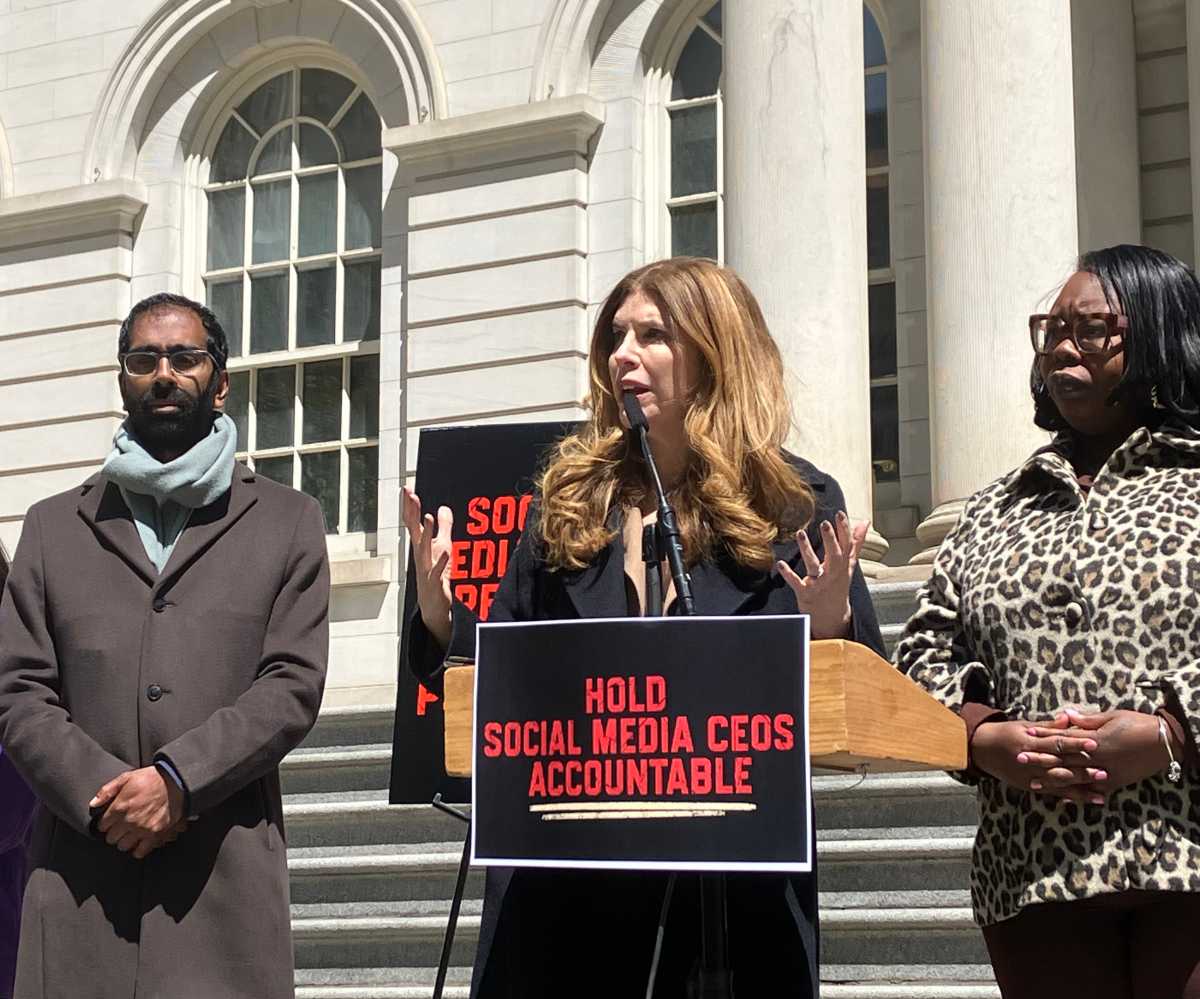
The New York City Council is pushing bills that would cap children’s social media use at one hour daily, but attorneys are warning the legislation could trigger First Amendment lawsuits against the city.
The bills, introduced by Council Members Althea Stevens of the Bronx and Nantasha Williams of Queens, would restrict social media access to 60 minutes a day for anyone under 17. A second provision would require reports on the online activity of people under 24 who attend Department of Youth and Community Development programming and get into in-person altercations. A hearing on the bills ran Tuesday at City Hall.
Supporters rallied outside before the hearing. Council Member Shekar Krishnan of Queens told the crowd the city needed to act. “We are here today to finally hold the billionaire social media CEOs accountable for pushing content that forces children to give them their attention,” Krishnan said. “Increasingly, that content is violent news, dangerous trends and fueling feelings of isolation and anxiety.” City Council Speaker Julie Menin joined the rally, along with Council Members Tiffany Caban of Queens and Stevens, who cited studies linking social media to declining children’s mental health and said students themselves have asked for protections.
The opposition isn’t coming from the platforms.
It’s coming from civil liberties lawyers.
Justin Harrison, senior policy counsel at the New York Civil Liberties Union, said the bill creates serious constitutional exposure for the city. “The bill has significant constitutional problems,” Harrison told reporters. “Teenagers have First Amendment rights, and that includes a right to browse the internet, a right to consume information, a right to find friends, find community and find networks online. This sort of blanket, one-size-fits-all approach that the city appears to be taking, limiting access to all the same content for all minors, is really too broad a measure.”
Harrison also flagged the age-verification piece. Requiring children to prove how old they are to access a platform raises serious privacy and surveillance concerns, he said, and courts are still actively debating whether such requirements pass constitutional muster. That’s not a minor procedural wrinkle. That’s the kind of unresolved legal question that gets bills gutted in federal court.
The monitoring provision drew sharp criticism too. Harrison argued that tracking the social media activity of people under 24 who get into altercations, in the detail the bill requires, would itself be unconstitutional. Caban said during Tuesday’s hearing that she shared those concerns. Advocates who testified before the council went further, warning the reporting requirement could lead to increased policing of young people. Caban, who represents a Queens district that includes some of the neighborhoods with the densest concentrations of young transit riders in the borough, said the surveillance angle worried her.
Then there’s the enforcement problem. Harrison and New York Law School professor Michael Goodyear both questioned how any of this would actually work in practice. Kids can use a VPN to spoof their location, making it look like they’re connecting from a state or country with no such restrictions. They can upload fake identification to convince a platform they’re over 17. Social media companies operating in good faith would have no reliable way to verify compliance, which means they’d face penalties for violations they couldn’t reasonably prevent. Goodyear, according to AM New York’s coverage of the hearing, joined Harrison in raising those practical enforcement gaps.
The tension here isn’t hard to see. Kids are struggling. That part is documented. The American Psychological Association has published extensive research on social media’s links to anxiety, depression, and disrupted sleep in adolescents. Council members aren’t wrong that platforms have profited from algorithmically serving children content designed to maximize engagement time, not wellbeing. Stevens and Williams introduced these bills because they see real harm in their districts every day.
But legislation that’s unconstitutionally broad doesn’t actually protect anyone. A bill that gets struck down in federal court the week after it’s signed protects exactly zero children. Harrison’s warning isn’t an argument against protecting kids. It’s an argument for writing a bill that survives the inevitable legal challenge, and the current versions, with their sweeping one-hour caps and surveillance mandates, don’t look like they’re built to last. The Council will need to answer Harrison’s constitutional objections before any version of this reaches a vote.