
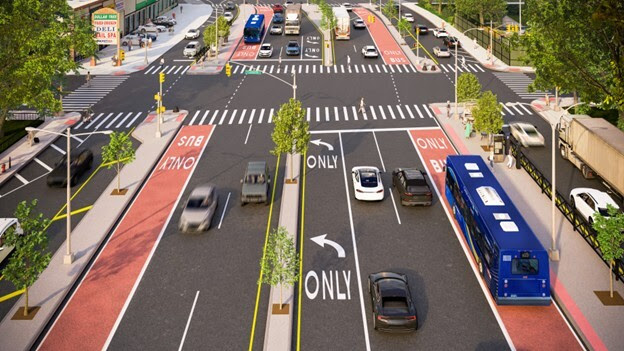
Brooklyn’s deadliest major boulevard is about to get a redesign, with Mayor Zohran Mamdani’s administration announcing Tuesday that the city Department of Transportation will install safety features and center-running bus lanes along Linden Boulevard between Fountain and Conduit Avenues in East New York.
DOT recorded one fatality and 443 injuries along that stretch between 2021 and 2025. The agency classifies Linden Boulevard as a Vision Zero Priority Corridor, meaning it ranks among the highest-injury roads in the borough. Buses on the corridor have been clocked moving as slowly as 4 miles per hour, stuck behind double-parked cars while riders wait to cross up to ten lanes of traffic just to board.
The scope of the overhaul is significant. Eight concrete bus boarding islands will serve as pedestrian refuges and cut crossing distances. New signalized intersections will go in at Pine and Emerald Streets. Five slip lanes will close. The work starts later this year, with completion expected by 2027.
The changes target a neighborhood where car ownership is low and transit dependency is high. DOT says 54% of residents living near the redesigned stretch commute by public transit, and 57% of nearby households don’t have access to a private vehicle. The nearest subway stop is at least a half-mile away, often farther, which makes the quality of bus service on Linden Boulevard not just a convenience issue but a matter of economic access.
DOT Commissioner Mike Flynn was direct about the stakes.
“Mayor Mamdani has tasked us with delivering fast buses for New Yorkers and our redesign of Linden Boulevard will help deliver on this promise for so many residents in East New York, where these buses are a lifeline to connect to jobs, healthcare appointments and so much more,” Flynn said in a statement covered by AMNY. “With the nearest subway a far walk away, residents here must cross 10 lanes of vehicle traffic just to board buses that end up stuck in traffic, behind double-parked cars, that is going to change under the Mamdani administration.”
Six bus routes benefit from the redesign: the B13, B14, B15, B20, BM5, and Q8. The project also promises better connections to six subway lines, the A, C, J, Z, L, and 3 trains, each sitting a substantial distance from the corridor itself.
Faster buses. That’s the core of it.
Mamdani made speed and reliability central to his transit platform during his campaign, and the Linden Boulevard project is being framed as proof of concept. Flynn’s statement made clear that the mayor sees bus service as an equity issue, not just a commuter inconvenience. East New York has long watched other neighborhoods get subway and bike infrastructure investments while its residents built their lives around buses that couldn’t keep pace with the clock.
“Redesigning this historically dangerous corridor will make it safer for everyone who has to cross it,” Mamdani said. “When we make our buses faster and our streets safer, we’re making a clear choice about the kind of city we want to be: one that puts people first.”
The Vision Zero program, launched more than a decade ago under a previous administration, designated priority corridors as a mechanism for targeting the city’s most dangerous streets. Linden Boulevard has sat on that list. What’s changing now is the pace and ambition of the response.
The pedestrian situation on Linden Boulevard has long frustrated local advocates. The road’s current design lets drivers speed across multiple lanes with little friction, forcing people on foot to make a long, exposed crossing with few protections. The eight boarding islands directly address that problem by shortening exposure distance and giving pedestrians a place to wait mid-crossing. The five closed slip lanes take away the acceleration points that make the road so dangerous at its edges.
DOT’s redesign plan also accounts for connectivity. Riders who transfer from the B13, B14, or Q8 to reach the J or Z at Jamaica Center, or the L at Canarsie, currently lose time at both ends of that trip, waiting for buses that crawl and then walking to platforms that sit far from Linden Boulevard. Faster bus speeds compound across a commute. A few minutes recovered at each transfer adds up over a working week.
East New York residents have waited a long time for a corridor this dangerous to get the engineering attention it needs. The city says construction starts before the end of this year, with full service improvements running by the time the project wraps.