
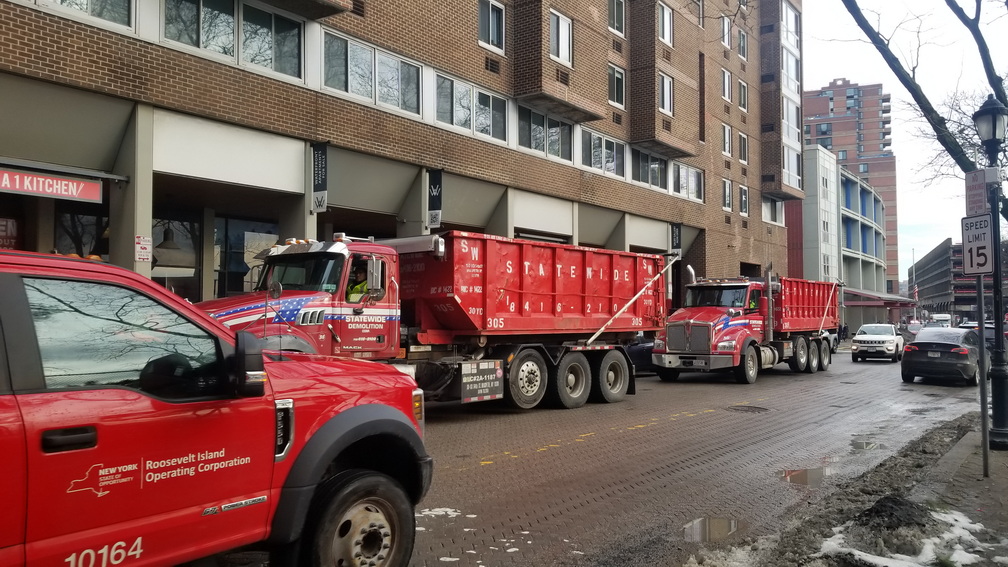
Rusted trucks are hauling open containers of industrial debris across Roosevelt Island’s Main Street every day, and the residents who live along that single strip of road want it stopped.
The vehicles, which make multiple daily runs through the narrow, mostly residential corridor between Queens and the Upper East Side, are tied to the demolition of the island’s old steam plant, a structure that opened in 1939 and was decommissioned in 2014. A growing coalition of neighbors says the city is rushing a teardown that doesn’t have to happen, and they’re using every tool they have to prove it.
They’ve already gotten traction. The group convinced Community Board 8 to adopt a unanimous resolution calling for a halt to the demolition and a serious look at adaptive reuse options for the building. More than 1,000 residents have signed a petition that organizers have been pushing at the subway station, at the Saturday farmers market, and across social media. These aren’t professional activists. They’re working parents who started showing up to public meetings after growing alarmed by what they say the city hasn’t told them.
The health question is what’s driving the sharpest anxiety. The trucks pass apartment buildings. They roll by the playground where children spend their afternoons. They go past the island’s sole elementary and middle school, every single day, with open containers. Residents say they don’t know what’s in those containers, and that’s precisely the problem.
They’ve sent emails. Filed public records requests. Asked for environmental assessments and demolition reports that city rules require. They say the answers haven’t come.
That silence reads as damning.
One resident, a journalist by trade who describes herself as someone who once welcomed the demolition of what she saw as a derelict eyesore, said the unanswered requests changed her mind. “The paper trail suggests demolition is a manufactured emergency,” she told AMNY, adding that the fight has become about more than a single building. “We believe a test of the democratic process is more important than ever given the dwindling faith in our public institutions.”
It’s a striking turn for someone who admits she used to be on the other side. She didn’t join the cause until February, after neighbors convinced her there was a different story to tell about what the city may have done, or failed to do, to create what the group calls an alleged pretext for tearing the plant down.
Roosevelt Island is genuinely unusual terrain for this kind of fight. It’s a sliver. One main road. A few thousand residents stacked into buildings that line the waterfront. There’s no alternate route for the trucks. There’s no way to avoid them. Everybody sees them, every day, which is part of why this issue caught fire so quickly and why the petition hit four digits in a relatively short stretch of organizing.
The steam plant itself has a specific kind of industrial grandeur that preservation advocates love. Built in 1939, it powered the island for decades before the city pulled the plug in 2014. That’s twelve years it’s sat there, which gives residents reasonable grounds to ask why demolition suddenly became so urgent that the paperwork couldn’t keep pace.
Under city rules, demolition is generally treated as a last resort, with required environmental reviews and documentation meant to show that no other option will work. The residents’ complaint isn’t sentimental. It’s procedural. They want to see the assessments that justify tearing the building down, and they say the city hasn’t produced them.
Community Board 8’s unanimous vote gives the coalition some political cover, but resolutions don’t stop construction crews. The trucks are still running. The demolition is still moving. And the group’s core argument, that this is a manufactured emergency cooked up to short-circuit a process that might have yielded a different answer, still needs someone with actual authority to act on it.
City Council members and borough officials have heard the pitch. Whether any of them pushes hard enough to actually pause the work is the question hanging over every run those rusted trucks make down Main Street.
The coalition says it isn’t done. The petition keeps growing, the public meeting appearances continue, and the records requests remain open and unanswered.