
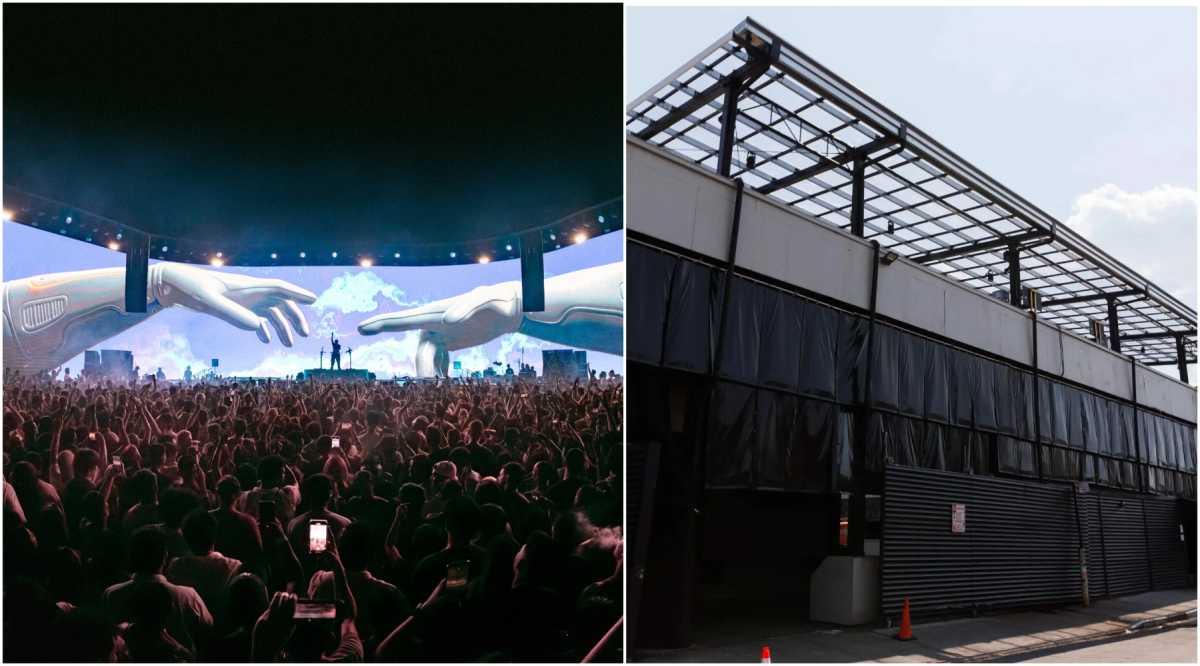
Pacha New York’s bid to revive the former Brooklyn Mirage ran into a wall of skepticism Tuesday night, as Community Board 1 members and neighbors pressed the company’s leadership on safety failures that defined the old venue.
FIVE Holdings chair and chief executive Kabir Mulchandani faced a packed, overheated room at the Swinging Sixties Senior Center in Williamsburg, where residents showed up with memories of drug overdoses, noise complaints, and bodies pulled from Newtown Creek. He came with a pitch. They came with receipts.
The stakes aren’t abstract. Pacha New York, which FIVE Holdings is launching at the old Mirage space alongside The Great Hall, has already sold tickets for its opening weekend. But the company still needs a liquor license from the State Liquor Authority, which means getting advisory approval from CB1 first. Without community buy-in, that path gets harder.
Mulchandani didn’t dodge the Mirage’s toxic legacy. He leaned into it.
“Once talking to members of the community, it has become exceptionally clear that there were many challenges this venue faced, but I don’t think the venue deserves the blame,” he told the board. “It’s the management that deserves the blame.”
That framing drew immediate pushback. The venue’s “challenges” included three fatal drug overdoses, repeated State Liquor Authority violations for chronic overcrowding, and a 2023 lawsuit alleging patrons were assaulted and harassed by security staff. That same year, politicians ripped the Mirage’s security operation after two visitors were found dead in Newtown Creek. Residents who lived nearby weren’t just annoyed. They were angry, and they’re still angry.
The Brooklyn Paper documented the crowd’s skepticism in detail, with neighbors describing years of booming bass rattling their apartments through the night and drunken concertgoers trashing their blocks in the early morning hours.
Then came the bankruptcy. Avant Gardner’s attempt to expand with a redesigned “Mirage 2.0” collapsed when the new structure failed inspection and had to be demolished. The whole thing was structurally unsound. That spectacular implosion cleared the way for FIVE Holdings to step in, and the State Liquor Authority approved the takeover.
Now Mulchandani is asking CB1 to believe his company will do what Avant Gardner couldn’t.
Pacha’s version would be smaller. The combined capacity for the former Mirage space and The Great Hall sits at 7,850 people, down from the roughly 9,600 that the never-opened “New Mirage” would have held. Mulchandani pointed to that reduction as evidence of a different mindset.
He also stressed that the Department of Buildings has already signed off on permits for the temporary structures Pacha plans to build on the site, a deliberate contrast with Avant Gardner’s self-certification approach that led to the structural failures. The DOB approval process cost more money and took more time.
“This is a way to be sure that what you’re doing complies with the regulations and with safety,” Mulchandani said. “It was far more expensive, far more time consuming, but we received approvals for everything we’re going to build.”
Board members weren’t buying it wholesale. The Mirage’s record with regulators is well-documented, and no amount of permit paperwork erases three deaths on your predecessor’s watch. The SLA’s history with this address runs long.
Smaller. Properly permitted. Different management.
That’s the case Mulchandani is making. It’s a reasonable case on paper. But for the people who watched ambulances pull up to that corner, who filed noise complaints that went nowhere, who saw the creek become a tragedy, reasonable on paper doesn’t cut it.
CB1’s advisory vote doesn’t bind the SLA, but liquor license proceedings rarely go smoothly when community boards formally oppose an application. Mulchandani knows that. His entire Tuesday night appearance was built around one ask, as he told the room directly: he was asking for a chance.
The New York City community board system gives residents formal standing to weigh in on exactly these kinds of applications, and CB1 covers one of the most nightlife-dense corridors in the five boroughs. The board’s recommendation carries weight with the SLA even when it doesn’t carry the force of law.
Pacha will get a vote. Whether CB1 gives it anything resembling a warm reception depends on whether Mulchandani’s promise of different management lands as more than a developer’s talking point to a room full of people who’ve heard it before.