
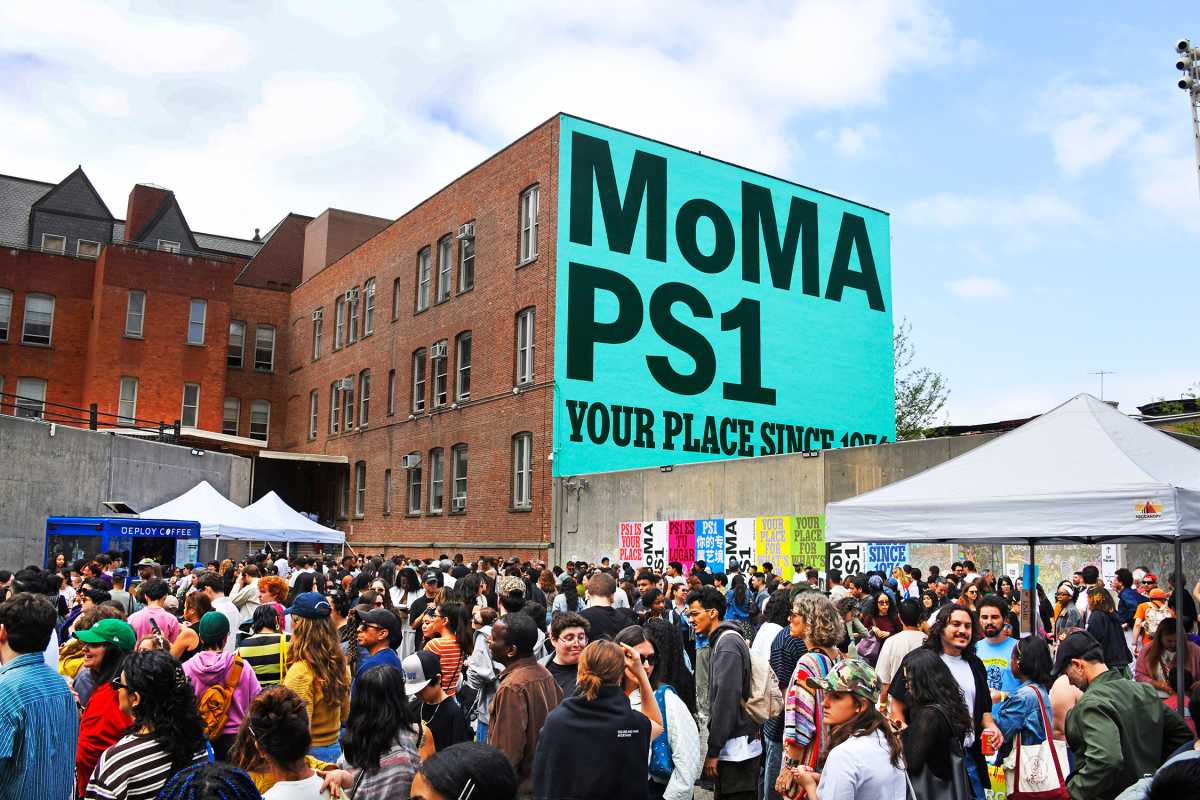
More than 8,000 people filled the streets outside MoMA PS1 in Long Island City on Saturday for the museum’s 50th anniversary block party, the largest free public celebration in the institution’s history.
The turnout surprised even the organizers. Museum director Connie Butler opened the festivities with remarks that acknowledged what she was seeing in front of her. “I’m so thrilled to welcome all of you here today to celebrate MoMA PS1’s 50th anniversary,” Butler said. “This is our first block party, and I can say it’s a huge success, because all of you are here.”
Queens doesn’t always get its cultural due from the city’s arts press, but Saturday made that oversight hard to sustain. The crowd spilled across the blocked-off street for hours, moving between graffiti workshops, family chalk walls, food vendors, and two floors of new work inside the building. Butler announced the opening of “Greater New York,” a group exhibition that the museum mounts every five years drawing on artists from across the five boroughs. “You’re among the first to see it,” she told the crowd. “It’s an every-five-years celebration of all the incredible artists and creatives in the five boroughs and beyond.”
The planning wasn’t casual. Chief Curator Ruba Katrib told AMNY the museum spent roughly five months putting the event together. “It’s really a full staff effort,” Katrib said.
The graffiti component drew some of the loudest energy of the day.
Lady Pink, one of the first-wave New York City graffiti writers and an artist whose work already covers the exterior walls of PS1, ran registered workshops where attendees picked up spray cans and made their marks on long stretches of temporary wall space. The workshops filled fast. For many participants, it was their first time holding a can.
That’s exactly what Pink wanted. She’s spent decades watching institutions treat art like a velvet rope. Saturday felt different to her. “Some museums make art seem stuffy and boring, but here they’re just having fun, no pressure,” she said. Asked what she thought of what participants produced, she didn’t hedge. “It’s a wonderful mess,” she said.
R+B and jazz singer Carmel St. Hilaire was one of those first-timers, stopping mid-spray to weigh in. “I’ve never done it before,” St. Hilaire said. “But I understand why people do this, it’s really fun!”
Kids. Parents. Grandparents. All of them grabbing chalk at the free-form wall nearby, adding to what became a full-scale outdoor art installation by afternoon’s end. A dad was photographed lifting a four-and-a-half-year-old so the kid could reach the upper portion of the wall. That image, more than anything else from the day, captured what the museum was going for.
Free admission has always been the PS1 model, and it has made the Queens museum a genuinely different kind of cultural institution from its Manhattan counterparts. The museum’s programming history stretches back to 1976, when it opened in a converted Long Island City public school building as an alternative space committed to experimental work. Fifty years later, the institution is showing it hasn’t lost that instinct for accessible, participatory programming.
The afternoon also included a screening of the documentary “Fly In Power,” which drew its own crowd inside the building while the block party ran in full swing outside. The dual programming kept foot traffic moving in both directions throughout the day, which likely helped sustain the energy well past the opening hours.
Butler’s remarks landed differently because she wasn’t pitching a donor or briefing the board. She was talking to 8,000 people who had just shown up because they wanted to be there, a mix of longtime PS1 regulars and families who’d never set foot inside the building. That’s the kind of audience that makes cultural programming in this city worth doing. Katrib and her staff spent five months building something for that audience, and the crowd that came out Saturday confirmed the investment in free public programming still pays off in New York, even now, even at 50.