
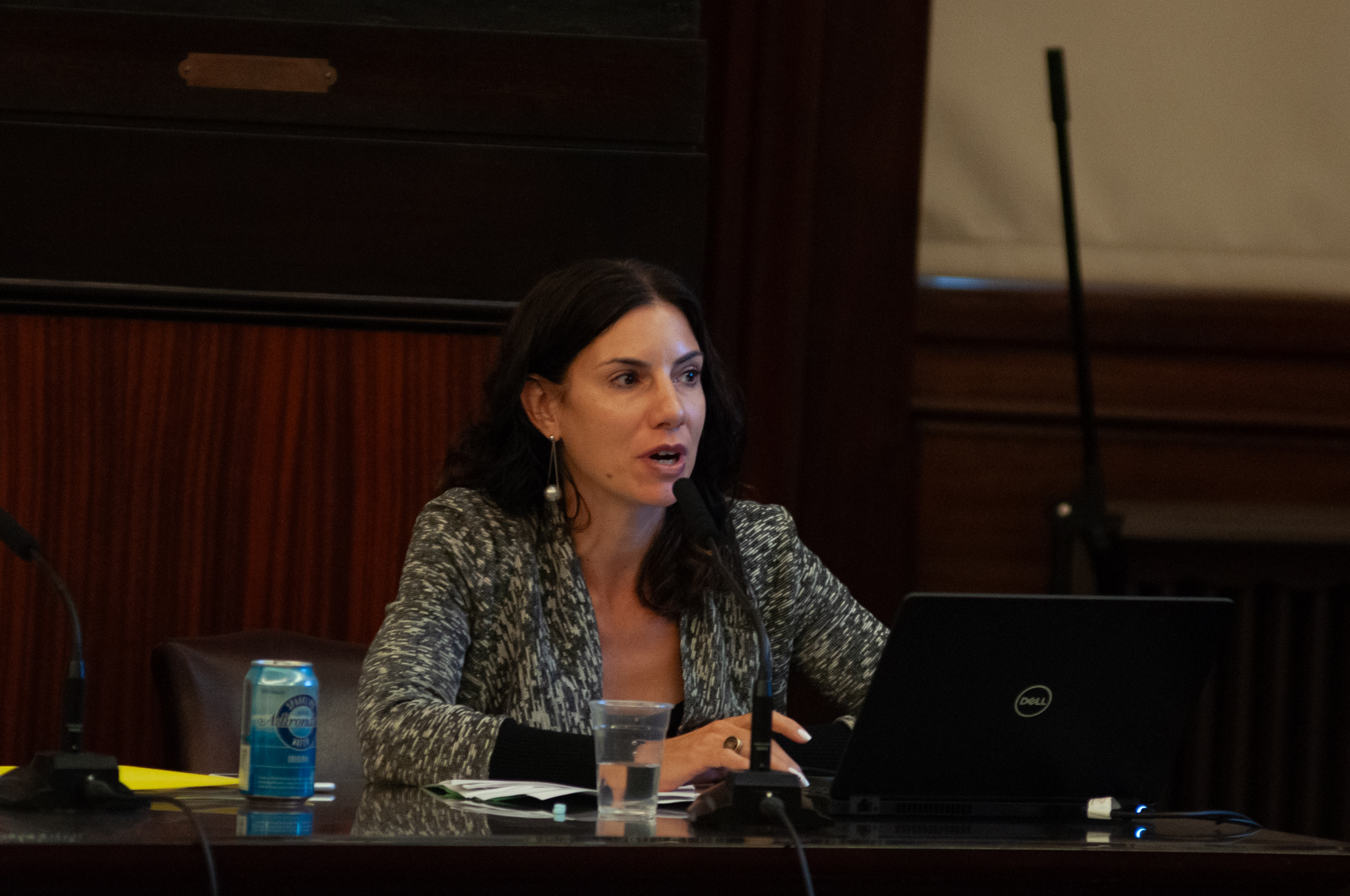
Dana Kaplan, a key architect of the original Rikers Island closure plan, has been named the Mamdani administration’s new “Rikers czar,” according to two sources close to City Hall.
Kaplan’s appointment has not been officially announced, and she did not immediately respond to a request for comment. But her hiring fills a role the city began advertising in March, seeking someone to “serve as a trusted advisor to the mayor” on the closure effort. The salary was listed at $180,000 to $230,000.
Liz Glazer, Kaplan’s former boss at the Mayor’s Office of Criminal Justice, said the pick was the right one. “Dana is a superlative choice to lead this complicated effort,” Glazer told The City. “This is a task that is beyond just Rikers, not just bricks and mortar, but changing the culture inside both for the people incarcerated and the officers.”
The city is legally required to shut down Rikers Island by 2027 and replace it with a network of smaller jails near courthouses. Mayor Zohran Mamdani has acknowledged the city won’t meet that deadline. He has supported the broader plan, though, and is pushing to accelerate the work after years of stalling under his predecessor, Eric Adams, who talked often about needing a “Plan B” but never detailed what that would look like.
After leaving the mayor’s office in 2022, Kaplan worked with the National Institute for Criminal Justice Reform and served as a senior advisor to the Independent Rikers Commission, where she became the public face of the campaign to close the complex. The creation of the Rikers czar role was itself one of that commission’s central recommendations.
For Brooklyn residents and families in neighborhoods like Brownsville and East New York who have watched the Rikers crisis drag on for a decade, the appointment carries real weight. Getting someone who helped write the playbook into the seat that’s supposed to execute it is the kind of continuity advocates have demanded.
The appointment comes as the city marked a concrete milestone Wednesday. Workers raised the final steel beam at a new downtown Brooklyn detention facility set to open in 2029, one of the replacement jails meant to allow Rikers to close. It’s a sign of tangible progress, even if the 2027 legal deadline is already out of reach.
Correction Commissioner Stanley Richards spoke to reporters at the event and didn’t soften his assessment of the existing facilities. “The facilities on Rikers Island are very old, decrepit, and they don’t speak life into our staff or the people in our care,” Richards said.
Richards drew on personal experience. He recalled being held at Rikers as a pre-trial detainee in his youth and watching his father make a grueling trip from the Bronx just to visit. “After that visit, I asked him not to come back,” Richards said. “We lived in the Bronx, and he had to take a bus, then a train, then another bus, just to get to the Island and go through the lengthy process of reaching one of the visit spaces in the jails.”
His father spent an entire day traveling for a one-hour visit.
That’s the human cost embedded in the geography. Rikers sits on an island in the East River, accessible only by bridge, far from the courthouses where detained New Yorkers face their cases and far from the families who come to see them. The replacement jails, built near borough courthouses, are designed to fix that.
Opposition to those new facilities hasn’t disappeared. Community groups in several neighborhoods have fought the construction for years, citing concerns about proximity to schools and residential blocks. That fight is likely to continue as the Brooklyn facility nears completion and the remaining sites move forward.
Kaplan’s job is to manage an effort that’s equal parts construction project, policy overhaul, and institutional culture change inside the Department of Correction itself. Glazer’s framing of the role as something bigger than “bricks and mortar” is apt. The new jails won’t solve anything if conditions and treatment don’t improve alongside the physical plant, and the people who’ve studied Rikers longest know that.
She steps into the role with Mamdani still in his first year as mayor, a new correction commissioner offering an unusually personal account of what Rikers does to the people inside it, and a construction timeline that extends at least two years past the legal deadline already written into city law.