
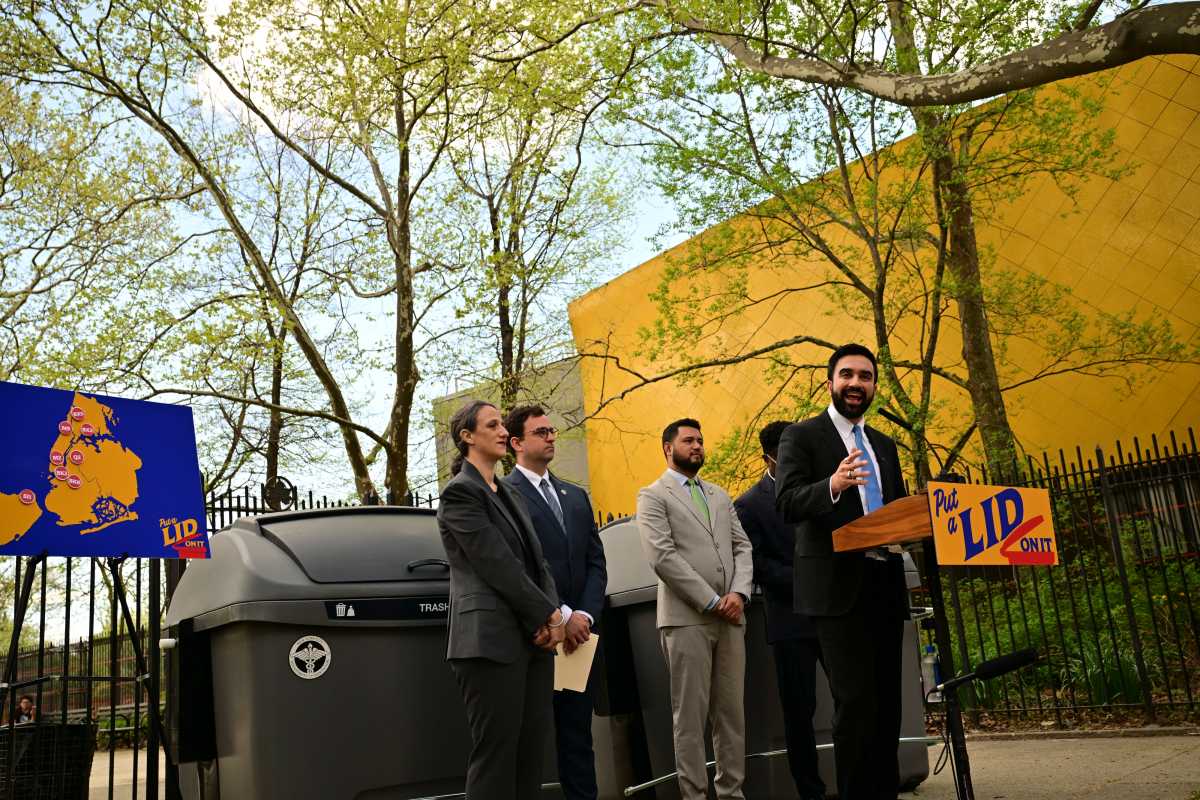
Mayor Zohran Mamdani announced Friday that thousands of large curbside containers will spread across all five boroughs, accelerating a trash containerization push that has reshaped how New York handles its most visible problem.
The city will convert more than 6,500 parking spaces into spots for the large lidded receptacles, known as Empire Bins, covering at least one Community District in each borough by the end of 2027. Full citywide deployment is set for 2031. The announcement came during a press conference in Crown Heights, Brooklyn, where Mamdani did not shy away from the symbolic weight of the moment.
“Black bags are in their twilight, the era of Empire Bins is now dawning,” Mamdani said.
He also aimed a joke at the city’s most loathed residents. “This is an issue for each and every New Yorker, no matter your politics. Frankly, the only disappointed constituency will be rats,” Mamdani said.
The rollout covers a broad geography. Districts slated for bins include Greenwich Village and SoHo in Manhattan, Crown Heights and Prospect Heights in Brooklyn, Sunnyside and Woodside in Queens, Hunts Point and University Heights in the Bronx, and the North Shore of Staten Island. That’s a long list. It’s also, for anyone who has stepped over a mountain of black bags outside a pre-war building on a humid Wednesday morning, a long time coming.
Empire Bins can only be picked up by specially designed side-loading garbage trucks, and building owners with 30 or more units in the covered districts will be required to use them. Access to each container will be controlled through a key card and an app, with details on the app still forthcoming. Building owners with properties of 10 to 30 units get to choose between Empire Bins and the city-branded wheelie bins that are already required for smaller residential buildings and businesses under rules put in place during former Mayor Eric Adams’ tenure.
The program, as AMNY reported, covers buildings where owners with nine or fewer units need only use the smaller wheelie bins. Taken together, those smaller bins already account for roughly 70% of the city’s trash, according to Mamdani.
The history here matters. Adams’ administration invented the Empire Bin branding and promised citywide deployment, but managed to fully implement the program in exactly one Community District, covering West Harlem in Manhattan. One district. Mamdani inherited the blueprint and a backlog.
The new mayor first signaled his intention to expand the program during his 100-day address on Sunday. That commitment surprised some budget watchers, because his $127 billion preliminary budget, released in February, didn’t include funding for expanding lidded containers. The administration hasn’t explained how it will close that gap.
Containerization is not just about aesthetics, though aesthetics are a real argument in a city that hosts more than 60 million tourists annually. The black bag system feeds rats directly, giving them reliable access to unsecured food waste on nearly every block in every borough. The bins, which are sealed and locked, cut off that supply. Pest control experts and public health advocates have long pushed the city toward containers for exactly this reason, arguing that extermination programs do limited good when the food source stays wide open each night.
City Hall under Adams did change the rules for small and medium residential property owners, requiring sealed wheelie bins rather than loose bags. That shift moved the needle. Mamdani is now going after the large residential buildings that were left out of that earlier mandate, the segment of the housing stock that has continued piling bags on the sidewalk while smaller buildings rolled out their bins.
The practical complications are real and not small. Retrofitting more than 6,500 parking spaces across a dense, politically fractious city means community board fights, constituent complaints from car owners, and logistical coordination across dozens of sanitation routes. The side-loading trucks required for Empire Bins are not the same vehicles that handle standard collection, which means the Sanitation Department needs to build out its specialized fleet in step with the bin deployment.
The administration has not released a detailed financing plan for the expansion or a borough-by-borough installation schedule beyond the 2027 milestone for initial districts and the 2031 citywide target. A spokeswoman for the Sanitation Department said additional details on the rollout timeline would be released in the coming weeks.