
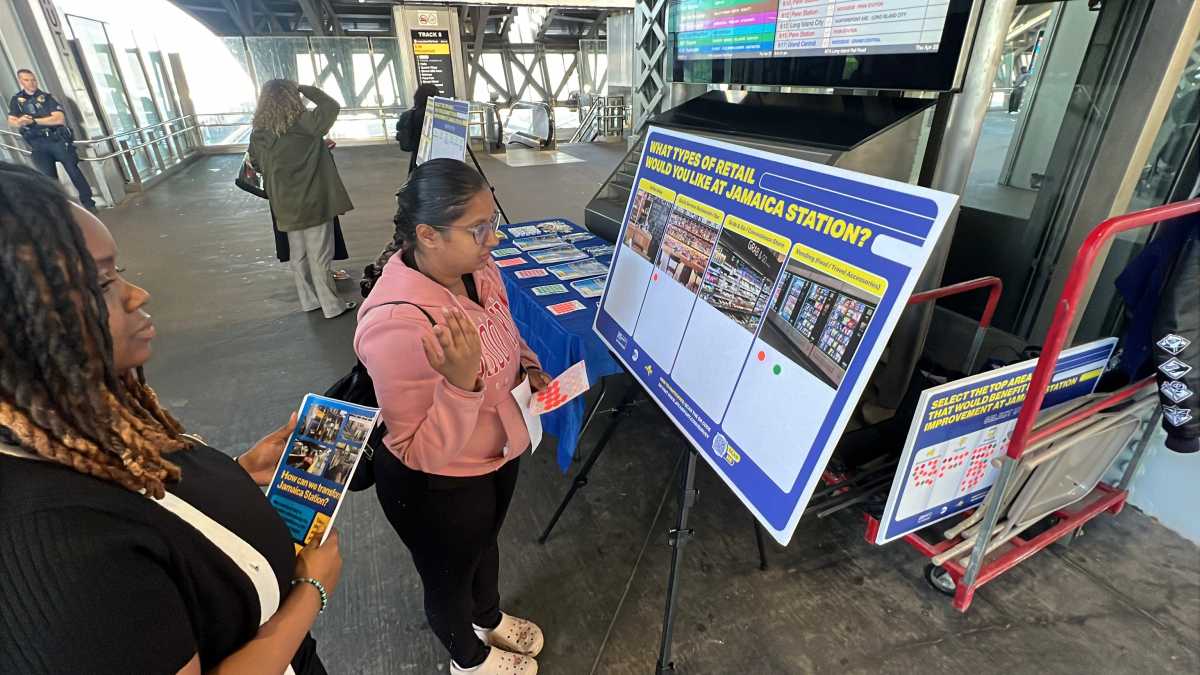
The MTA took its Jamaica LIRR redesign pitch directly to commuters Thursday, setting up tables at the station to hear from the 200,000-plus riders who pass through every weekday.
State Sen. Leroy Comrie joined Metropolitan Transportation Authority officials for the outreach launch, which coincides with a customer survey running until Friday, May 8. The timing isn’t accidental. Gov. Kathy Hochul has already committed $50 million in the executive budget to fund planning for a full station redesign, and the MTA wants rider input locked in before that planning gets too far along.
Jamaica Station moves more than 1,000 subway and LIRR trains through its platforms every weekday, ranking it the fourth busiest commuter rail station in North America. Only Grand Central, Penn Station, and Toronto’s Union Station handle more. That’s not a minor operation.
Yet the last time anyone seriously invested in the place was 23 years ago, when AirTrain JFK began operation. Since then, ridership has climbed, the LIRR’s Main Line got a new third track, and Grand Central Madison opened, pulling in commuters from Westchester and Connecticut who now connect at Jamaica before heading to JFK. The station’s infrastructure hasn’t kept pace with any of it.
“Jamaica Station is a key access point to JFK Airport for customers coming from New York City and from Long Island, as well as Westchester and Connecticut thanks to the new connection at Grand Central Madison,” LIRR President Rob Free said. “A newly redesigned Jamaica will improve the customer experience and meet the increasing service demands of the millions of customers who connect there. Customer feedback means we’ll know exactly what those millions of riders want to see in their new station.”
The numbers Free is referencing are worth sitting with. Before Grand Central Madison opened, 481 trains stopped at Jamaica on a typical weekday. That figure has since jumped to 790, a 54% increase that the station’s aging layout was never designed to absorb. Anyone who’s tried to navigate the Jamaica platform connections during peak hours knows exactly what that math feels like on the ground.
Comrie, whose district covers much of the area around the station, said the redesign has stakes that go well beyond train connections. “Jamaica Station is more than a transit hub, it’s a daily touchpoint for families throughout Queens,” Comrie told officials at the outreach event, as reported by QNS. “As we look ahead to redesigning this space, it’s important that the voices of the people who use it every day are central to the conversation.”
He specifically flagged the connection between the station and York College and downtown Jamaica, calling for upgrades that make the corridor safer, more accessible, and more seamless. That’s not a small ask. Anyone who walks that stretch regularly understands the gap between what the station currently offers and what a major transit hub serving millions of people should provide.
MTA Construction and Development President Jamie Torres-Springer also spoke at the event, pointing to the station’s regional role. “Jamaica Station is a critical transportation hub for the entire region, connecting millions of riders to their destinations every year,” Torres-Springer said.
The outreach push combines in-person tabling with the online survey, which closes May 8. MTA officials say they want direct feedback on how riders experience the station today and what they want from a rebuilt version. That includes everything from platform access to wayfinding to the AirTrain connection that currently sends JFK-bound travelers through a transfer sequence that can feel more like an obstacle course than a designed system.
For commuters on the Long Island Rail Road’s branches that funnel through Jamaica, including the Far Rockaway, Long Beach, and Babylon lines, this station is inescapable. It’s not a hub they choose. It’s one they’re routed through, day after day, whether the infrastructure deserves that traffic or not. The MTA’s capital program has historically struggled to match investment with actual ridership load, and Jamaica has paid the price for that gap for two decades.
The $50 million Hochul put in covers planning, not construction. What eventually gets built will depend on what the planning process produces, what riders say they need, and what the MTA can fund in future capital cycles. The survey closes May 8, and the agency says community input will shape the scope of the redesign before any design work begins in earnest.