
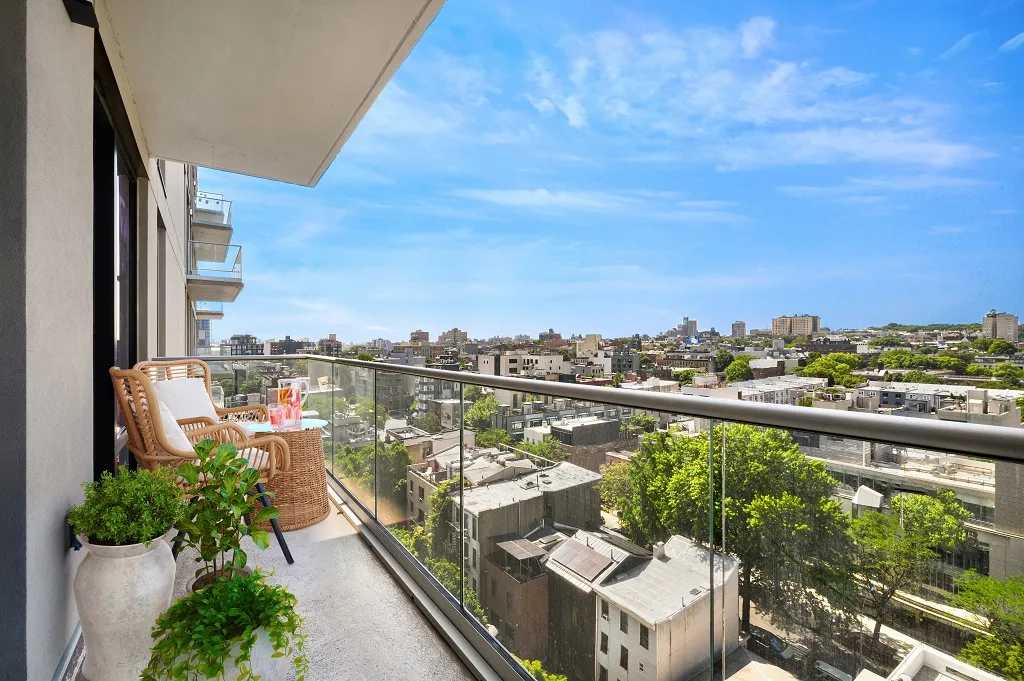
A lottery for 65 rent-stabilized apartments at a new 19-story tower on Atlantic Avenue in Prospect Heights opened this week, offering studios as low as $962 a month in a neighborhood where market-rate rents run far higher.
The building, Eight80 BK, sits at 880 Atlantic Avenue between Vanderbilt and Washington avenues and holds 258 total apartments. The majority are market rate. The 65 lottery units are all rent stabilized and tied to income limits, with 52 set aside for households earning 40 to 60 percent of Area Median Income, which works out to $38,538 to $77,760 a year, according to the NYC Housing Connect listing.
Those 52 units break down to five studios renting at $962 and $1,542 a month, 32 one-bedrooms at $1,013, and 15 two-bedrooms at $1,169. The remaining 13 units target households earning 130 percent AMI, or $87,840 to $227,500 annually, with a studio at $2,400, seven one-bedrooms at $2,790, and five two-bedrooms at $3,250.
That’s a wide spread. Studios for working-class Brooklynites sit in the same lottery pool as apartments priced near three grand a month.
Critics of mixed-income lotteries have long argued that bundling deeply affordable units with 130 percent AMI apartments inflates the headline number of “affordable” homes without delivering proportional relief to the families who need it most. Housing advocates have pushed the city for years to require a higher share of genuinely low-income units in market-rate buildings, particularly along corridors like Atlantic Avenue, where displacement pressure has intensified over the past decade.
Eight80 BK was the product of a controversial spot rezoning, approved before the City Council passed a broader Atlantic Avenue rezoning covering the surrounding area. The building was already under construction when that larger areawide rezoning cleared the Council, putting it ahead of any community negotiation that might have extracted deeper affordability commitments from the developer, EMP Capital Group.
The tower replaced a row of two-story mixed-use brick buildings and a car dealership. Gone is the low-slung street scale that defined this stretch. What replaced it is a 19-story grid of floor-to-ceiling windows, textured brickwork, and dark paneling, designed by Issac and Stern Architects. The paneling starts at a setback that steps up from the 10th floor, with terraces depicted in renderings as lush with plantings.
The amenity list runs long.
A movie theater. A game room. A yoga room. A sauna with a cold plunge pool. A pickleball court. A pet washing station. A spa and a garden. The listing warns that some amenities may cost extra on top of rent.
Renters can bring up to two pets with a combined weight limit of 50 pounds and must pay a $300 refundable deposit. Kitchens include dishwashers and GE, Bosch, and Summit appliances, according to the development’s website. Tenants cover electricity, which also pays for hot water, heat, and the stove.
“We don’t want people to get into a lottery thinking they’re getting a deal and then find out the amenity fees and utility costs eat into their budget,” said Deb Howard, a housing counselor with a Brooklyn nonprofit who works with low-income applicants navigating the NYC Housing Connect system. “The full cost of living in these buildings isn’t always clear upfront.”
Eight80 BK is the latest tower to rise along this stretch of Atlantic Avenue as developers swap out one- and two-story commercial buildings for high-rise residential. The pattern runs from Flatbush Avenue west through Prospect Heights and into Crown Heights, reshaping blocks that held auto shops, hardware stores, and small businesses for generations. Community groups and local electeds pushed for the broader Atlantic Avenue rezoning partly to bring that transformation under more predictable rules, requiring affordable units and design standards before approvals are granted.
Whether the spot-rezoning path that Eight80 BK took would be available to future developers under the new framework is less clear. The Council’s approval of the areawide rezoning is meant to channel development through a process that includes public review and affordability requirements, but buildings already in the pipeline under the old rules aren’t subject to the new standards.
Households between one and five people can apply for the 52 lower-income units. Applications are processed through the NYC Housing Connect portal, where income documentation and household size are verified before any lease is signed. Lottery applicants who qualify for the building’s affordable tiers have until the deadline posted on the listing to submit their applications.