
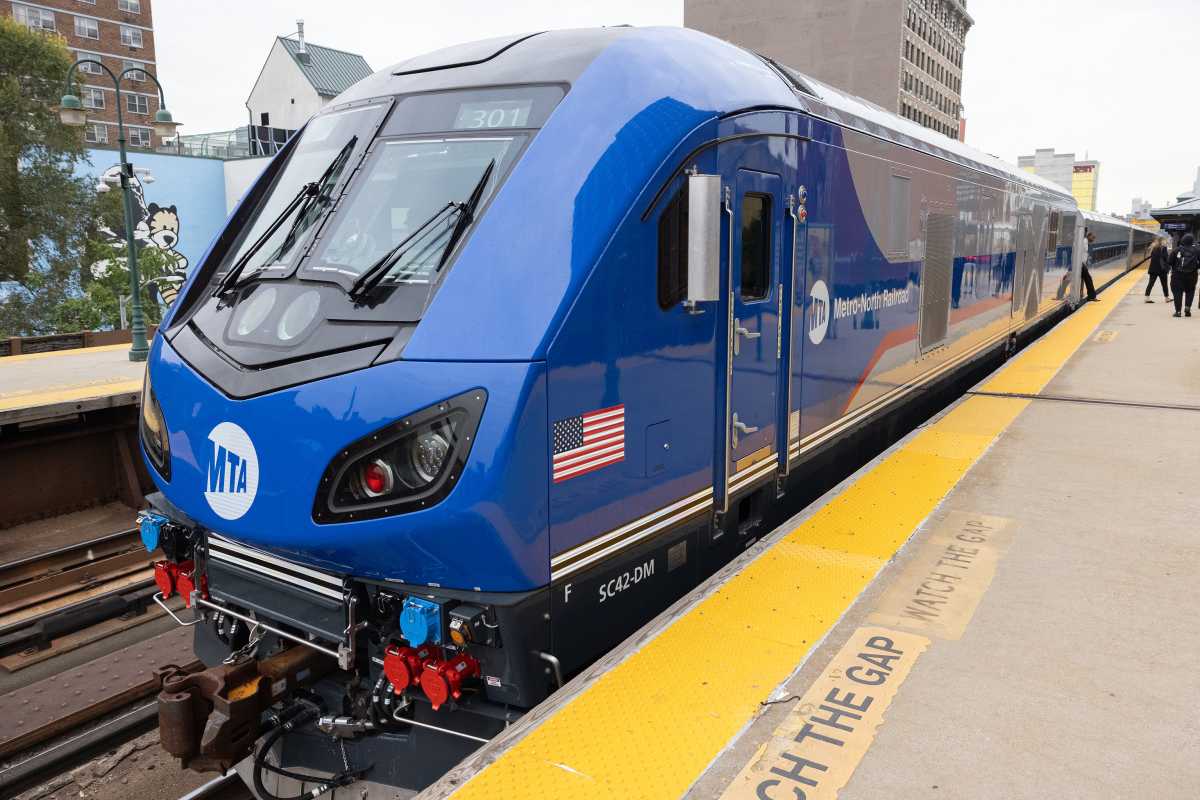
Amtrak dragged the MTA into Manhattan federal court Thursday, claiming Metro-North is blocking its trains from the shared Bronx tracks it needs to keep passenger service running.
The MTA didn’t flinch. John J. McCarthy, the agency’s external relations chief, called the lawsuit a distraction from what he said is the real fight: Amtrak’s failure to give the MTA the access it needs on its own Hell Gate Line tracks to build four new commuter rail stations in the East Bronx.
“It’s not clear who in the federal government is directing Amtrak’s lawyers to create distractions from the real issue, getting Bronxites the service they deserve,” McCarthy said. “The people of the Bronx have been waiting generations watching trains blow by without stopping. We have a project that will change that and improve lives for people in the Bronx.”
Amtrak did not respond to a request for comment.
The dispute turns on two overlapping stretches of track in the Bronx where Amtrak and the MTA share ownership and operating rights but each controls a different segment. Amtrak owns the Hell Gate Line. The MTA owns the New Haven Line corridor. Both carriers run trains on both stretches, which is exactly what makes this fight so tangled.
Amtrak’s suit, filed Thursday in Manhattan federal court, says Metro-North has been denying the national carrier its routine access to the MTA-owned New Haven Line tracks they share, blocking Amtrak from repositioning equipment, running maintenance trains, and conducting test runs of new trains at the frequency it requires. “Metro-North’s ongoing denials are causing escalating harm to Amtrak’s operations and to the traveling public,” the complaint says. “Amtrak’s inability to reposition its equipment along Metro-North’s lines has already forced Amtrak to cancel and delay passenger train runs.”
The MTA’s position is that the access crackdown followed damage Amtrak’s Acela trains caused to overhead wires on the MTA-owned portion of the corridor. Amtrak’s suit frames the MTA’s response as retaliation.
But the MTA’s bigger grievance sits on the other side of this equation entirely.
The Penn Access project, which will build four new Metro-North stations on the Hell Gate Line and eventually serve an estimated 30,000 new daily commuters, has been grinding through delays the MTA blames directly on Amtrak. The plan is to extend Metro-North service so that trains running between Connecticut and Penn Station stop at four East Bronx stations rather than barreling through the borough without pausing. The MTA is paying for that construction. Amtrak had agreed to provide the necessary Hell Gate Line track access to get the work done. The MTA says Amtrak hasn’t fully honored that agreement.
McCarthy’s statement made clear the agency sees Thursday’s lawsuit as a legal flanking maneuver. Not a genuine grievance.
The MTA and Amtrak have been sparring over Hell Gate Line access for years. As AM New York reported, the dispute has escalated to the point where the federal carrier is now seeking court intervention to force the MTA’s hand on New Haven Line access, even as the MTA argues the construction delays Amtrak caused are the more consequential harm.
The Penn Access project carries stakes that go well beyond the two agencies trading legal motions. The East Bronx is one of the most transit-starved corridors in the city, a dense stretch of neighborhoods that sit close to the Hell Gate Line tracks but don’t see a single stop. Four new stations would change commute patterns for tens of thousands of residents who currently have no direct rail option to Midtown. The project has been in development for years, and construction delays driven by any party don’t just cost money. They cost riders.
It’s a classic New York infrastructure standoff: two agencies sharing the same physical infrastructure, each accusing the other of bad faith, each with a legitimate claim somewhere in the pile.
What happens next is up to the Manhattan federal court where Amtrak filed Thursday. The MTA will have to respond formally to Amtrak’s complaint, and the Hell Gate Line access dispute may well end up before the same judge at some point, since the MTA has made clear it considers that the central issue. Construction on the Penn Access stations cannot proceed at full speed without the track windows Amtrak controls, and no court order covering the New Haven Line changes that arithmetic.