
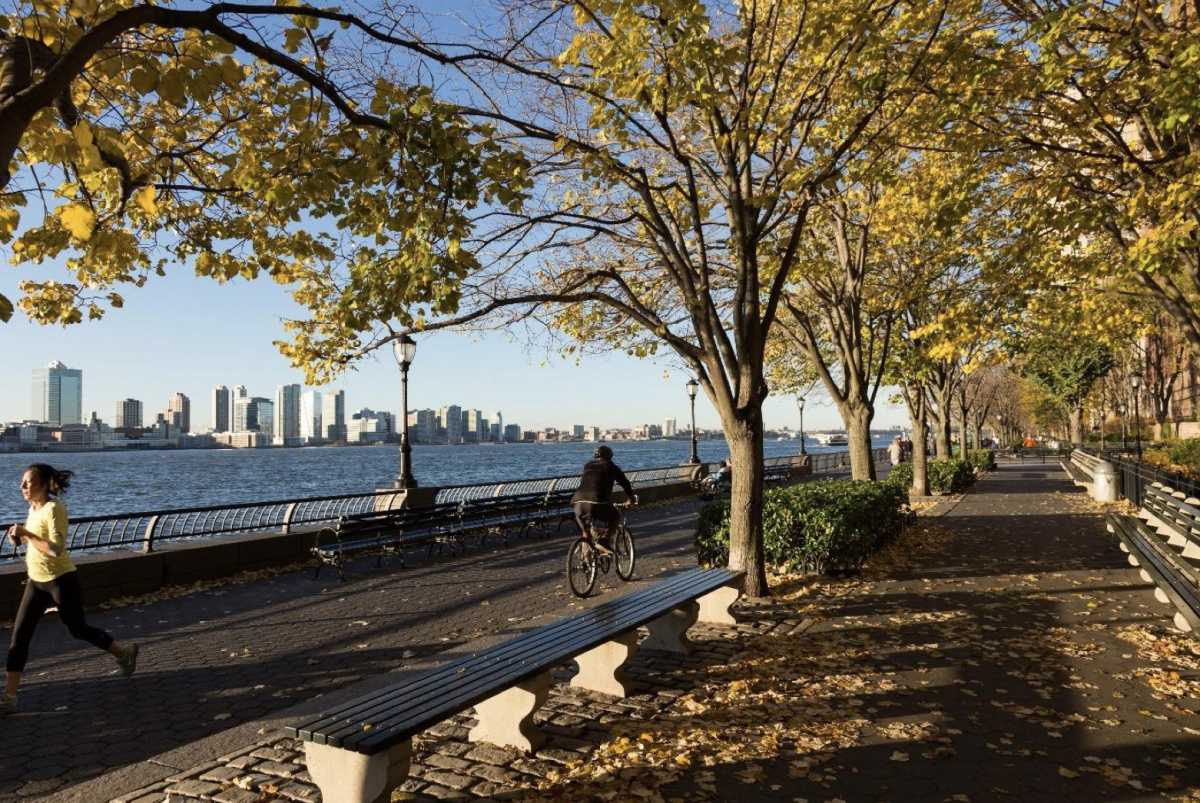
The Battery Park City Authority told a Manhattan Supreme Court judge last week it can’t move forward with flood protection work without access to one Lower Manhattan condo building.
The state authority filed suit against Cove Club Condominium, arguing that without court-ordered access to the building, critical flood walls and underground drainage structures around Battery Park City simply won’t get built on schedule. The $2 billion coastal flood risk management system has been in development since 2015, and the northwest portion of the project is now stalled because one property owner won’t open its doors.
Dead stop.
“The project is a very significant undertaking and represents a large investment in the future of Lower Manhattan and the region at large,” the Battery Park City Authority’s court filing reads. “Yet [BPCA] cannot [move forward on] the portion of the project adjacent to the [Cove Club Condominium] because [the condo] has denied [BPCA’s] countless requests to install temporary protections on the premises required by the New York City Department of Buildings.”
A spokesperson for the Battery Park City Authority told amNewYork that the authority filed suit as a last resort after exhausting every other option. The access BPCA needs isn’t invasive. It involves installing vibration monitoring equipment, work the authority describes as generally non-disruptive, meant to protect residents inside the building and in the surrounding area during construction.
The stakes here are enormous. BPCA says the flood system, built in direct response to Hurricane Sandy’s destruction, will eventually cover more than a mile of Lower Manhattan’s southern edge. When complete, it’s designed to shield 120 buildings, 25,000 residents and 61,000 jobs, including critical infrastructure and cultural institutions such as the World Trade Center. Flood risks for the entire area are expected to grow exponentially over the next 30 years.
Requests for comment from Cove Club Condominium and its management company were not returned. The condo doesn’t yet have attorneys on file in the case.
The lawsuit lands against a messy backdrop of community resistance along the project’s route. Some building owners and residents whose properties sit at Manhattan’s southern edge have pushed back against the flood protection work for years, pointing to construction disruption as their main grievance.
That tension broke into open litigation last November. Neighborhood groups Battery Alliance and Battery City Park Association sued BPCA over this same northwest stretch of the project. They argue construction will harm the park, damage trees and disturb nearby property. That suit is still pending.
It’s not the first time BPCA has faced that kind of opposition. The same two groups, Battery Alliance and Battery City Park Association, made comparable arguments about the southern portion of the project back in 2022, and the state authority prevailed in both of those earlier cases.
So far, the courts haven’t sided with the resistance. But the Cove Club situation is different in structure. It’s not a dispute over whether the project should exist. It’s about whether workers can physically get inside a privately owned building to do monitoring work before the heavy construction even starts. Without it, BPCA says, the required sign-off from the New York City Department of Buildings won’t come.
The authority hasn’t said publicly what its next step will be if the court doesn’t grant access quickly. What’s clear is that the timeline is tight. The northwest portion of the project is already the portion most visibly tangled in legal fights, and every week of delay puts a chunk of the broader resiliency effort further behind.
For residents of the Bronx, Upper Manhattan and the outer boroughs who watched the flooding that followed Hurricane Sandy tear through low-lying neighborhoods, the slow grind of this project carries real weight. The storm killed dozens, flooded transit lines and caused tens of billions of dollars in damage across the region. The system BPCA is building is one of the largest climate resiliency investments the state has made since that disaster. Letting a single access dispute unravel a segment of it would represent a significant setback for a project that’s already been in the works for more than a decade.
Manhattan Supreme Court hasn’t yet issued a ruling on BPCA’s access request.