
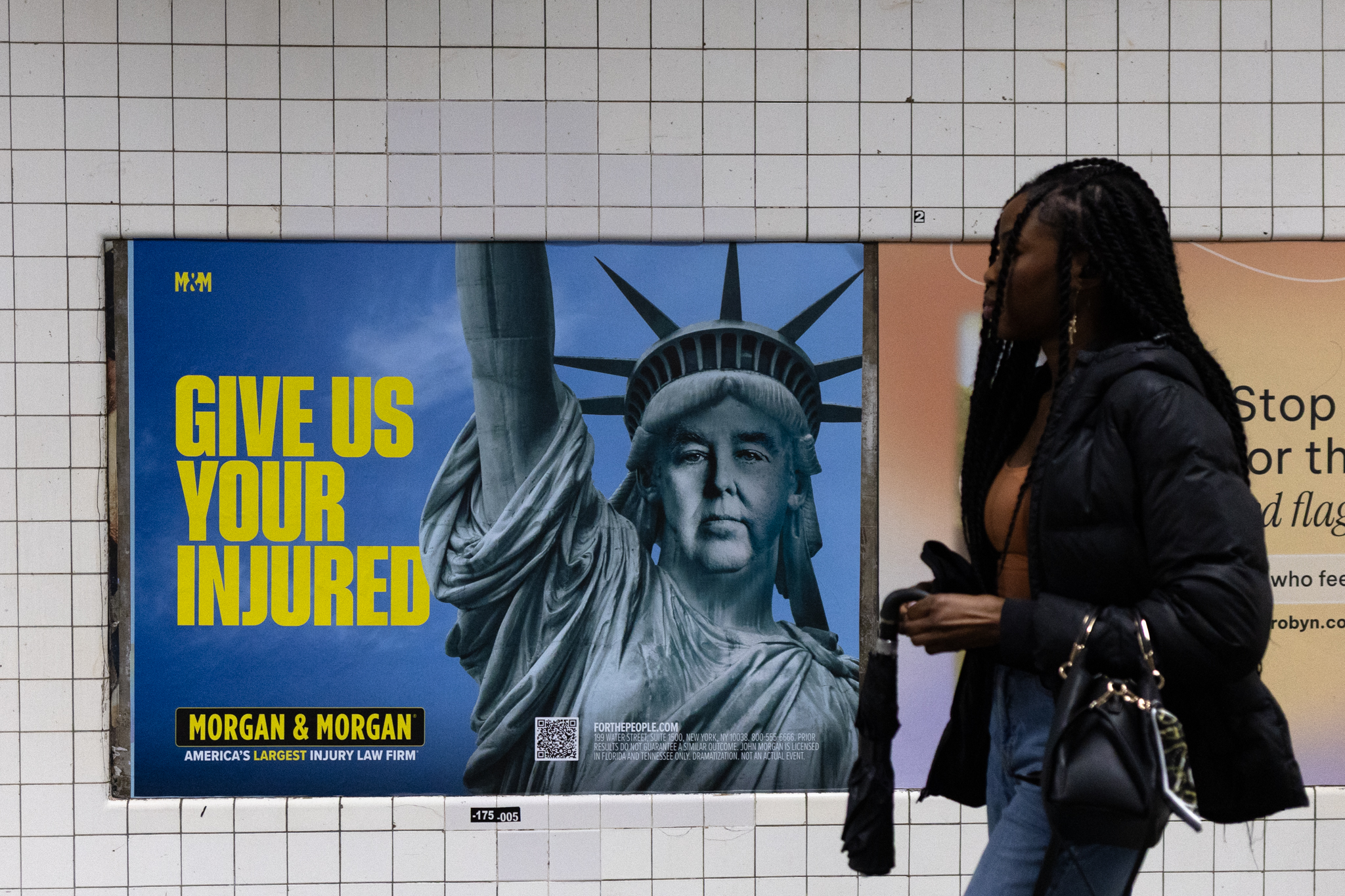
Personal injury lawyers spent heavily to plaster their faces across the MTA’s subway cars, train stations, and bus stops in April 2026, even as transit officials pushed Albany for lawsuit reforms they say the system desperately needs.
The MTA paid $561 million in claims in 2025, up from $454 million the year before. The authority’s budget documents don’t break down how much of that sum came from personal injury cases specifically, but MTA chief Janno Lieber has made clear he views the litigation pipeline as a serious drain on a system already starved for operating dollars.
Lieber put it bluntly at a January board committee meeting. “When there’s an auto accident, the lawyers tend to look around and say, ‘Was there an MTA bus anywhere nearby?’” he said. “Because if we can be made responsible for even 1% of that crash, there are all of a sudden very big potential payouts because we are the deep pocket.”
He’s also taken to describing the situation in starker terms, saying some personal injury attorneys “seem to think the MTA is actually spelled ATM.” That line gets laughs. The $561 million figure doesn’t.
The lawyers aren’t hiding. They’re advertising.
Step into any B train car heading toward DeKalb Avenue and you’re likely to see at least two competing firms staring back at you from the overhead ad panels. Brooklyn-born Michael Lamonsoff, who markets himself as “Michael the Bull,” runs ads showing him flexing in a superhero costume with a bull on his chest and another on a Captain America-style shield. His website claims more than $12 million in payouts for clients hurt in a train derailment, plus additional seven- and eight-figure settlements.
Lamonsoff told THE CITY he has an “infinite” number of cases against the MTA. He doesn’t apologize for the theatrics.
“I’m someone who is confident enough to portray myself as a person equivalent to a superhero,” Lamonsoff said. “I feel like the work I do is that of a superhero.”
Transit officials see it differently. They’re backing Gov. Kathy Hochul’s push for auto insurance reforms designed to cut costs and weed out fraudulent claims, with the MTA’s exposure to “deep pocket” liability suits as a central argument for the overhaul.
Also advertising heavily in the system is Harris Keenan & Goldfarb, whose ads feature partner Seth Harris glowering under the tagline, “Nice on the outside. Killer in the courtroom.” It’s a slogan you’d expect on a billboard on the Staten Island Expressway, not hovering over a grandmother’s head on the SI Ferry connection to the R train. But that’s where it lives.
Then there’s John Morgan, whose firm calls itself “America’s Largest Personal Injury Law Firm.” Some of his subway ads show a cartoon man in a suit riding a pigeon above Manhattan.
“That’s me,” Morgan told THE CITY.
Morgan runs ads in Yankee Stadium, on Times Square billboards, and throughout the subway system. He defended the volume of it without much hesitation.
“I look at advertising kind of the way I look at a meal — you need some greens and you need some starch and you need a protein and you need a dessert,” Morgan said. “I’ve got outdoor, I’ve got radio, I’ve got television, I’ve got social, it’s just part of the meal.”
The whole arrangement has a circular quality that can’t be dismissed. The MTA sells advertising space to firms that then sue the MTA. The authority collects ad revenue from lawyers who cost it hundreds of millions in settlements and legal fees. Riders pay higher fares and watch service cuts partly because claims costs keep climbing, and they do so while reading ads from the attorneys who file those claims.
Lieber and Hochul want Albany to tighten the rules around what counts as MTA liability and how damages get calculated. The personal injury bar, predictably, opposes restrictions. They argue they represent real people hurt in real crashes and on real platforms with real maintenance failures, and that framing those clients as fraud vectors is both inaccurate and unfair.
That argument has genuine weight in a system that has logged real accidents, real signal failures, and real platform gaps over many years of deferred maintenance. Riders on the Staten Island Railway, the Q, or any of the crosstown buses know the infrastructure isn’t flawless. The MTA’s own capital program exists precisely because so much needs fixing.
What’s harder to defend is a claims total that jumped more than $100 million in a single year, landing at $561 million in 2025, with no clear ceiling in sight.