
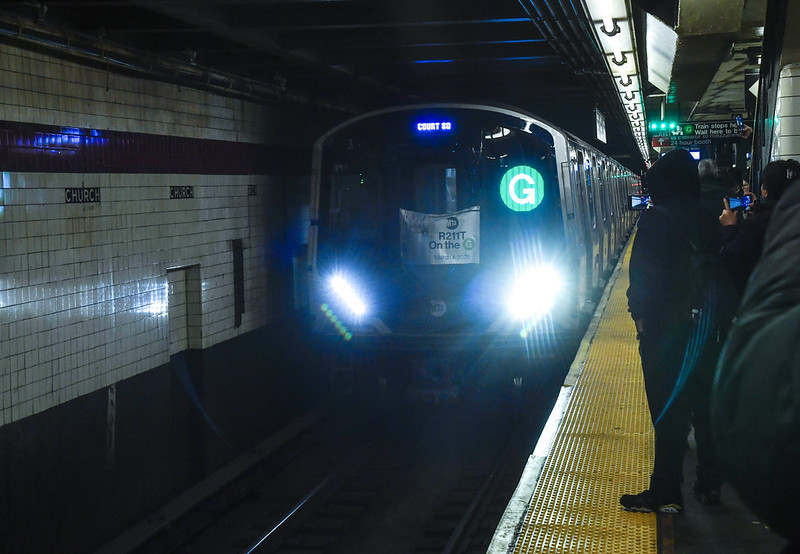
G train riders face a punishing stretch of weekend outages this summer, Brooklyn lawmakers warned this week, with disruptions potentially hitting every weekend in June and stretching deep into fall.
Assembly Member Emily Gallagher and City Council Member Lincoln Restler, who both represent neighborhoods along the crosstown line including Greenpoint and Williamsburg, went public with the warnings over the weekend and into Monday. Gallagher took to social media Sunday to share what the MTA had told her: diminished service every weekend in June, two weekends in August, one in May, and one in September. She didn’t specify what form the reduced service would take each weekend.
“These shutdowns have disastrous impacts on our community,” Gallagher said. “Small businesses lose customers in their busiest months. These shutdowns impact social connections, weekend work shifts, and our wallets.”
Gallagher called the coming disruptions “unacceptable.”
She’s not alone.
Restler’s office said the MTA is planning to shut down the G over 10 weekends and two dozen weeknights through the rest of the year. Restler scheduled a news conference for Tuesday with Brooklyn Borough President Antonio Reynoso and local business leaders in Greenpoint to highlight what he described as the “devastating impacts” of the disruptions.
For Greenpoint residents, the stakes are especially high. The G is the only train serving the neighborhood, a fact Gallagher said makes the repeated service cuts feel like a direct punishment on her constituents. The line also holds a unique place in the city’s subway map as the only train running between Brooklyn and Queens without passing through Manhattan, which is how it earned the crosstown designation.
What makes the current warnings sting more is what happened last summer. The MTA shut down large portions of the G for much of the summer of 2024, and officials told riders that was supposed to be it.
“We were told that last year’s shutdowns would be the end,” Gallagher wrote. “They made this schedule without communication, much less collaborative planning.”
MTA spokesperson Aaron Donovan, when asked about Gallagher’s social media post, didn’t confirm the specific shutdowns she described. He pointed instead to service changes already announced for weeknights this week and next, along with adjustments the agency made to the G’s route and schedule throughout this month. During those disruptions, where the agency suspended large portions of the line, the MTA ran T403 shuttle buses hitting G stops as an alternative for riders.
The agency has framed the work as necessary to modernize the G line’s train communication systems, known as signals, while also completing track work along the route. An MTA source told AM New York that the agency regularly briefs elected officials and community boards on planned service changes months ahead of time, but acknowledged that such information is subject to change and that riders won’t get full details until closer to each disruption.
That approach isn’t sitting well with the lawmakers. Gallagher’s criticism cuts to a real tension between how the MTA handles long-range planning internally and what it actually tells the public and local representatives who depend on the line. Planned months out. Shared weeks out. That gap is the problem.
The G has long been the subject of frustration among Brooklyn and Queens riders. It runs from Church Avenue in Kensington, Brooklyn, up through Park Slope, Carroll Gardens, and Cobble Hill, continuing through Williamsburg and Greenpoint before crossing into Long Island City and terminating at Court Square in Queens. Despite serving densely packed, transit-dependent neighborhoods, the line runs shorter trains and less frequent service than many comparable routes in the system.
The upcoming schedule of disruptions, if confirmed in full, would represent one of the most concentrated periods of G train outages the line has seen. Ten weekends represent more than two months’ worth of Saturdays and Sundays without full service, a burden that falls hardest on neighborhoods like Greenpoint where riders don’t have a backup subway option.
Restler’s Tuesday news conference in Greenpoint figures to draw more scrutiny toward the MTA’s planning process and its communication with the communities it serves. Gallagher’s public push, combined with Reynoso’s involvement at the borough level, signals that the political pressure on the agency isn’t going to ease up as the summer approaches.